
The first flakes of autumn followed by clear, sunny weather, were enough to bring some ski tourers out of hibernation and three of them had a lucky escape on Thursday, 22 October, after triggering an avalanche on the Saint-Sorlin glacier, just below the summit of the Pic de l'Étendard (3,464m), in the Grandes Rousses massif. The accident comes unusually early in the ski season, following the first autumn snowfalls.
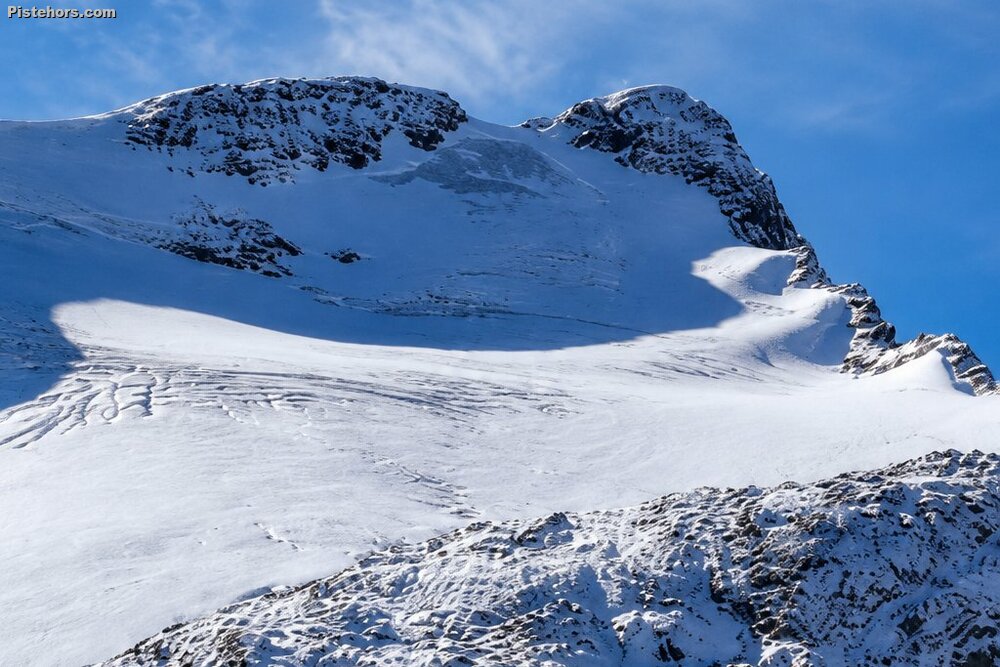
The three skiers, all in their twenties, were descending a northwest-facing slope just below the summit at approximately 3,400 metres when the first two members of the group triggered a slab avalanche. The fracture was reportedly around 30cm deep.
Two of the skiers were caught with one travelling approximately 150 metres down the mountain. Fortunately, neither was buried or seriously injured. Mountain rescuers from the CRS Alpes at Modane were called out at around 1.30pm, and the three skiers were subsequently taken to hospital in Saint-Jean-de-Maurienne suffering from shock.
Rescuers pointed out that the outcome could have been considerably worse, particularly given the danger of being swept into a crevasse on the glacier.
The accident is particularly striking given the limited snowfall so far this autumn. Observations in the region on 22 October indicated snow cover beginning at approximately 1,700 metres, with around 5cm at 2,000 metres and perhaps 10cm at 2,500 metres.The col de la Croix de Fer (2065m) was closed to vehicles yesterday due to the snow so the three ski tourers also risk a fine.
Conditions were different higher up, where recent snowfall had deposited locally between 20 and 30cm, according to reports from mountain rescuers. The Saint-Sorlin glacier, extending towards the summit of the Étendard, may have offered sufficient snow cover for skiing, despite the largely bare slopes at lower elevations.
Wind is likely to have played an important role. During the snowfall, winds averaged approximately 30km/h, with gusts reaching 45km/h, sufficient to transport fresh snow and deposit it in sheltered areas. These accumulations can form cohesive wind slabs over weaker snow, creating dangerous conditions even when the overall snow depth is modest. The northwest-facing slope involved in Thursday's accident appears to have been particularly susceptible, although the precise structure of the snowpack has not yet been established.
One complication for early-season ski tourers is the absence of regular avalanche forecasting. Météo-France has not yet begun issuing its seasonal avalanche risk bulletins for the area, and there are few observers on the mountain to assess snow stability. This does not mean that avalanche danger is absent. Above 3,000 metres, particularly on shaded slopes exceeding 30 degrees, fresh snowfall combined with wind can produce hazardous conditions long before the ski resorts open.
The Étendard accident is a reminder that a thin early-season snowpack can present a serious avalanche hazard. On the 27th September 2007 two walkers were caught by an avalanche above the lac du Crop in the Belledonne mountain range while climbing a couloir filled with 40cm of fresh snow. On glaciated terrain, where crevasses, rocks and other obstacles remain poorly covered, the consequences of being caught can be severe even in a relatively small avalanche. We will have to see how the situation evolves. Last season a thin snowpack at altitude transformed into fragile facetted snow crystals and presented a danger throughout the season (persistent weak layer).
2025/26 Avalanche Conditions