
After a long period of calm conditions in France last weekend saw a series of avalanche which killed 6 off piste skiers and left others injured. We thought we'd analyse these events to see if there are lessons for the remainder of the season and debunk some of the myths we've seen on social media.
Before the weekend of the 10-11th January the last significant snow was in early December. This left a thin snowpack and anticyclonic conditions. The cold, clear weather, especially leading up to the 9th when temperatures plunged, left a strong temperature gradient in the snow-pack. Surface temperatures were frequently -10 to -20C below zero with the ground at around 0C. This created a layer of hoar crystals, sometimes the entire snow-pack was comprised of these crystals which made for nice skiing in what the American's call "loud powder" due to the noise it makes as you ski through.
The avalanche bulletins across the Alps have been warning about these persistent weak layers for weeks. We spoke about the problem throughout November and again on Thursday the 8th January right before last weekend's incidents. The truth certainly was out there.
Saturday
On Saturday 10th January the avalanche risk was given as 4/5, High. The wind had been blowing from the south west all day between 80 to 100km/h transporting snow and even cross loading gulleys far from the usual traps of ridges and summits. Specialists had warned of the danger of large, skier triggered avalanches over the weekend. There had been up to a meter of fresh snow in the region. The avalanche bulletin for Val-d'Isère had also warned of a persistent weak layer in the snow-pack saying that slabs were extremely sensitive to skier triggering on any slope over 30° with the risk of remote triggering of large avalanches on shallow slopes. Slabs could be up to 150cm deep.
At 14h00 two middle aged male skiers from Nantes were off piste below the col de la Bâthie in the small ski area of Arêches-Beaufort in the Beaufortain mountain range. A piste patroller heard cries for help and found a man buried up to his neck, he was taken to hospital with multiple injuries. His friend, completely buried, was not so lucky and died at the scene. The zone already saw a fatal incident in 2018 when two skiers were killed by a slide.
 Vallée perdue
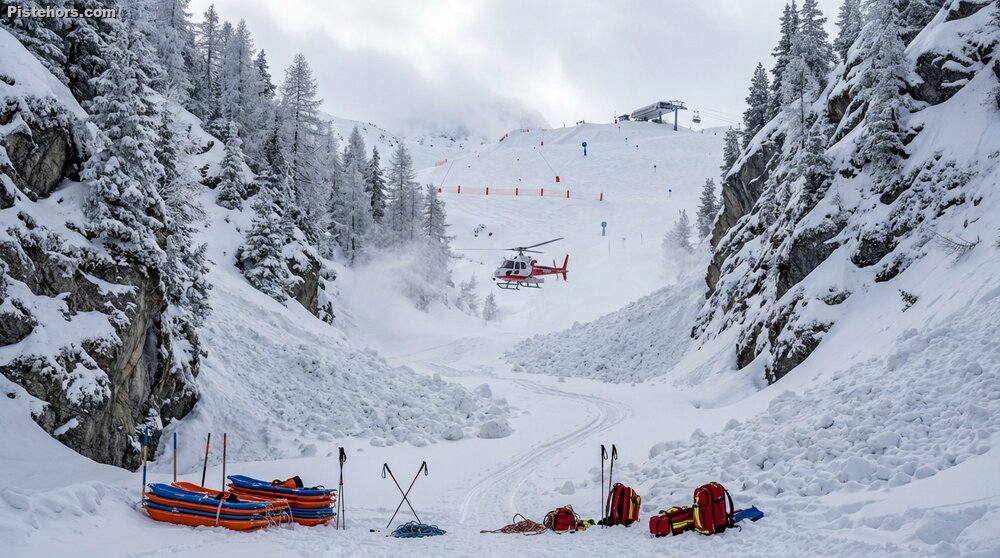
Shortly afterwards the alert was given in Val-d'Isère. A group hadn't seen their two friends return after skiing the Vallée perdue. Guided by the gps location from their mobiles the pisteurs localized the missing men under 2.5 meters of snow. An avalanche had buried them from above and the narrow canyon had served as a terrain trap. The men had been buried for over an hour. Neither victim had an avalanche beacon.
Three Spanish off piste skiers had more luck in the Pyrenees at Formiguères. They lost ski gear and one skier suffered facial injuries but they were rescued by the piste services, after a 4 hour delay due to the difficulty to access the zone due to the conditions.
Sunday
The fatalities continued on Sunday. The Courchevel piste patrol witnessed the slide at 11h40 in the north east facing Creux Noirs sector. A high mountain guide intervened immediately to assist the victims before rescue services arrived. Unfortunately one of the skiers was killed by the slide.
At 13h30 an English skier in his fifties was killed by an avalanche in the Verduns Sud off-piste area in the Champagny-en-Vanoise. He was just off piste between the Bosses black and Hari Kiri on a South-East facing slope at 2200 meters altitude. Caught by a medium size avalanche on a rollover the skier was taken into a gulley and buried under 2.5 meters of snow in a terrain trap. Despite the deployment of significant rescue resources it took 50 minutes to recover him.
Mountain rescue teams were called shortly before 15h00 to an avalanche in the central Posettes couloir above the village of Vallorcine, near Chamonix. Two men were caught by the slide. One of them, a 32-year-old ski patroller working at the Flégère ski area, was violently thrown against a tree and died from his injuries.The slopes above Vallorcine require respect when the avalanche risk is high.
At 15h00 there was an avalanche in Méribel Mottaret in the Tougnette sector above the Blaireau piste (marker 11) on a NNE facing slope around 2300 meters altitude. Two skiers were caught by the slide, one was able to trigger his airbag and remained on the surface. The second was completely buried. Fortunately he had an avalanche beacon and was localized quickly but the recovery, under 2 meters of snow was slow despite the considerable efforts deployed at the scene. Reports are that the skier did not survive, adding a 7th victim.
On Sunday the avalanche risk was 4 out of 5 above 1600 meters altitude across much of the Savoie and authorities had called for extra caution saying the risk was "maximum" for back country travelers. Meteo France warned that there are numerous reactive slabs with remote triggering possible. Breaks could reach 1.5 m with significant mobilizable volumes of snow, giving rise to size 2 to 3 (medium to large) avalanches that can travel far onto flat terrain. In a large northern sector size 4 avalanches couldn't be ruled out breaking on a deeply buried weak layer.
Several other avalanches were reported during the day. At Tignes, a snowboarder was partially buried in the lake at 9h30. He was skiing a NW facing slope around 2100 meters altitude. In Orelle, two off-piste skiers without avalanche transceivers were caught in a slide around midday in the south facing Plan Bouchet sector at 2500m; one was seriously injured and airlifted to hospital, while the other escaped unhurt.
In the Hautes-Pyrénées a group of six off piste skiers were caught by a slide above Barèges around 10h00. The slide, measuring 200 meters, buried one of the skiers. Equipped with avalanche rescue gear they were able to rescue their friend before the mountain rescue arrived. The resort organsied a search over the debris to ensure no other skiers were buried.
Summary
There are a number of factors involved in these slides. The avalanche risk was 4/5 over much of the region. This can be considered the maximum risk for back country travellers as risk level 5 is aimed at the authorities and concerned infrastructure risks. It was noticeable that ski tourers, perhaps better informed of the risks were largely active in mountain ranges with risk 3 and frequently below the treeline at lower altitudes where the risk was lower. Not only was the risk High it was at the upper end of the scale - the weak layer was generalized under the fresh snow, was sensitive to skier triggering, even remotely and slides could be deep, a mixture of fresh snow and wind loading under storm force winds. It was a day to stay on piste or pick low angle terrain with no risk from above, yes safer off piste was still possible.
The Verduns and Vallée perdue slides were aggravated by terrain traps. Skiing a canyon in the case of the Vallée perdue and a flat run out at the Verduns. Lack of avalanche beacons was significant in at least three incidents and an airbag probably saved one skier from serious injuries at Méribel Mottaret where the open slope was particularly conducive to this kind of equipment. On Tuesday a Tignes skier was also saved by his airbag after triggering a massive avalanche doing ski jumps off piste.
Skiers on social media referred to the rapidly warming temperatures on Sunday saying they were taking less risks as they only skied "just off piste in the morning" but as can be seen a number of incidents occurred early in the day and the slab that killed the British skier at Champagny-en-Vanoise was already in place in the morning. There is an affect of "nibbling" where as the day goes on skiers explore further and onto more dangerous slopes as the safer, easier terrain gets tracked out. However a thaw concerns principally natural slides not slab avalanches. Again the British skier was also "just off piste". He probably felt he was reasonably safe traversing between two ski runs on slopes that were already heavily tracked in places.
A second claim was that the fresh snow fell onto a hard, icy base. Again the incidents above involve slab avalanches triggered on over 30 degree slopes due to a weak layer buried in the snow-pack. This could be one of the persistent weak layers highlighted by the bulletin or a temporary weak layer formed at the interface of the old and new snow. These temporary layers tend to stabilize within 24 to 48 hours. They do not depend on the quality of the base. Snow slabs weigh hundreds of tonnes. The don't just "slide off" the base due to the extra load of an 80 kg skier. They are triggered due to the skier or boarder punching down to a weak layer, on a jump, fall or turn and causing that weak layer to collapse - that's when you hear the whoump noise as you ski over a slab. Given that most of the slabs were 150cm deep the trigger would be on a spot where the slab is thinner, for example on a roll over where the snow has been eroded.
The depth of burial was significant in a number of incidents. Again an airbag can keep you on the surface and alive if the slide occurs on a wide, open slope without obstacles but can be overwhelmed by terrain traps. Another social media claim was that the other victims "would have been saved if they'd only had avalanche beacons". This is not clear. Although time was clearly a factor in both cases the Vallée perdue skiers would have needed to have practiced safe travel, skiing one at a time, to at least have had a chance of giving a quick alert. In the case of the Verduns and Tougnette avalanches the burial depth made the recovery time consuming even with a large team relaying. The flat burial area in the Verduns avalanche is particularly difficult to excavate as it is complicated to clear the debris. For a 2 meter burial depth you need to be digging at least a 2 meter wide hole, that's 4 cubic meters of snow to shovel.
Further Information