
Following France's hottest summer on record and an exceptionally dry autumn, webcam comparisons from several major French ski resorts have revealed unusually low water levels in some reservoirs used for artificial snowmaking. Not all reservoirs are affected, but with natural snow cover considerably thinner than last November and the first resorts preparing to open, questions are emerging about their capacity to produce enough artificial snow for the coming winter.
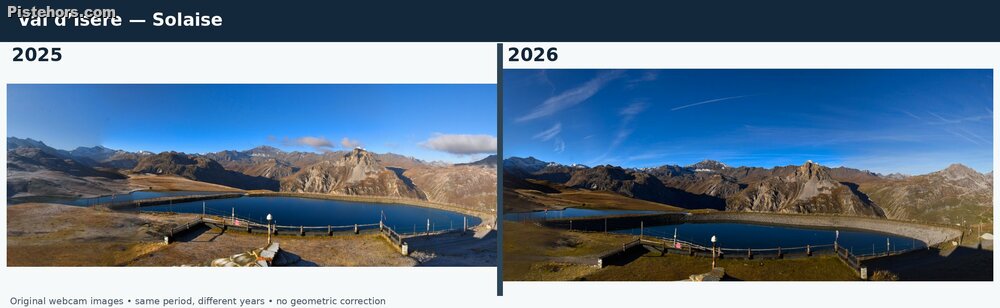
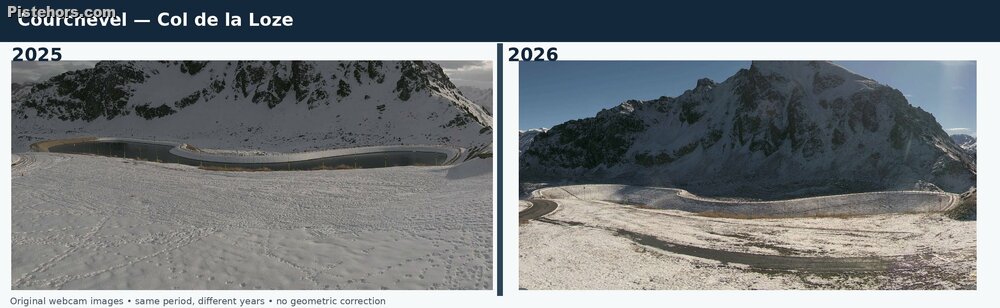
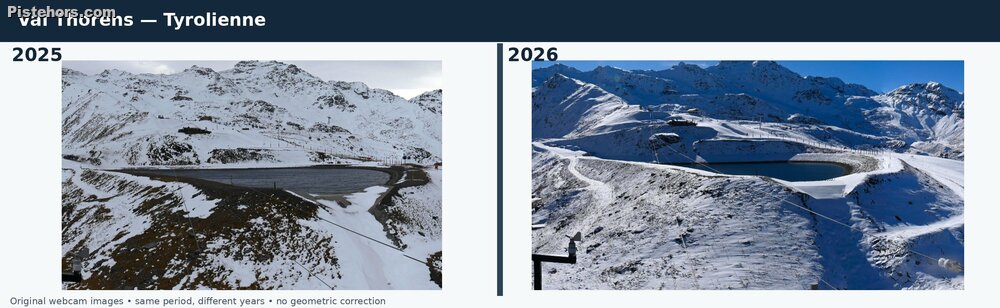
At Courchevel, the reservoir near the Col de la Loze, at approximately 2,300 metres, has remained almost empty throughout the autumn. At Val Thorens, the Tyrolienne reservoir holds visibly less water than at the same time in November 2025. A similar comparison at Solaise, above Val d'Isère, reveals a substantially lower waterline. These observations come from webcam images taken at comparable dates in 2025 and 2026. They do not establish the precise volumes of water available, but the differences are striking.
The climatic background is extraordinary. According to Météo-France, the summer of 2026 was the hottest recorded in France since measurements began in 1900. Average temperatures were 3.6°C above the 1991–2020 normal, exceeding the previous record set in 2003. France experienced 53 days of heatwave conditions during three separate episodes, compared with 33 days in the exceptionally hot summer of 2022. Rainfall was almost 40% below normal, making it the second-driest summer on record. Soil moisture fell to unprecedented levels across much of the country.
The heat continued into September, which became the second-warmest September on record and the third-driest. National rainfall was approximately 70% below normal. In the Savoie, the deficit exceeded 60%. At Bourg-Saint-Maurice, in the Tarentaise valley, the temperature reached 34.7°C on 4 September, an exceptional figure for the time of year.
The consequences were felt across the Alpine catchments. Mountain streams, springs and groundwater reserves came under increasing pressure as the dry weather continued. October brought some welcome rainfall, but the improvement was uneven. In a statement published on 5 November, the Savoie prefecture reported that rainfall in early and mid-October had improved river flows and begun replenishing some groundwater resources. However, most of the rain had fallen in the western part of the department. The higher mountain catchments in the east, including much of the Tarentaise and Maurienne, received less precipitation. The authorities warned that the rainfall was insufficient to compensate for the preceding months of drought.
Some groundwater reserves had continued falling until mid-October, approaching the exceptionally low levels observed during the droughts of 2022 and 2023. The departmental groundwater monitoring network reported that the Frasses spring, near La Plagne, had experienced declining discharge since spring. By late October, its flow had stabilised at around 16 cubic metres per hour, but remained moderately below normal. Although some resources had begun to recover, the authorities cautioned that this did not necessarily mark the end of the drought. Water restrictions were consequently maintained, although relaxed in some areas, until at least 20 November.
A series of webcam comparisons gives an interesting indication of how different ski areas are entering winter.
At Courchevel, the reservoir near the Col de la Loze has been almost empty throughout the autumn. This is especially noteworthy because artificial snow production in the Three Valleys only began on 10 November. Its low level therefore cannot be explained simply by water consumed during the first few days of snowmaking.
At Val Thorens, the Tyrolienne reservoir is visibly lower than at the same point last year. However, another reservoir lower down the mountain appears to contain approximately the same amount of water as in November 2025. It is possible the upper reservoir has partially been used to fill this reservoir.
At Val d'Isère, the Solaise reservoir also shows a substantial reduction in water level compared with last year. Webcam observations indicate that it was already low during the autumn.
There are several possible explanations. Reservoirs may have different sources of water, filling schedules or operating priorities. Some may be connected to other storage facilities, allowing water to be pumped between them. Maintenance work or deliberate drawdown cannot be ruled out. The photographs therefore do not prove that drought has caused the low water levels. However, the fact that some reservoirs remained depleted before snowmaking began makes reduced autumn replenishment a reasonable possibility to investigate.
The water situation is potentially more concerning because of the poor early-season snow cover. Webcam comparisons show considerably less snow on the ground than at the same time last year. At the Col de la Loze, around 2,300 metres, the pass remains largely snow-free in mid-November. In early November 2025, the area was already covered by snow. At Val Thorens, rain reached approximately 2,800 metres during the past week, although cold spells have allowed snowmaking to operate down to around 2,300 metres.
The resort is scheduled to open on 21 November, but natural snow cover remains thin. This combination of warm weather, limited natural snowfall and potentially reduced stored water creates a difficult situation for ski resort operators. Artificial snowmaking requires sufficiently low wet-bulb temperatures, which depend on both air temperature and humidity. Short periods of cold weather can allow snow production, but subsequent warm or wet conditions may damage the newly established base. Resorts may therefore need to produce substantial quantities of artificial snow during relatively short cold windows. Nowadays resorts like to lay down a substantial artificial base before the season starts. This helps preserve any real snow that falls on the pistes and avoids bare patches appearing during the winter season. Webcams already show the higher Trois Vallees pistes covering in piles of artificial snow.
Most major ski resorts have invested heavily in dedicated water-storage facilities, known in France as retenues collinaires. These allow water to be collected when it is available and used later during cold periods, reducing the need for direct withdrawals from streams during winter low-flow conditions. However, reservoirs do not create additional water. They transfer its availability from one season to another, and their filling can affect other water users and aquatic environments.
The environmental organisation Mountain Wilderness has repeatedly questioned the expansion of artificial snowmaking infrastructure, particularly in areas suffering prolonged drought. In October 2026, the organisation highlighted a controversial project at Les Angles in the eastern Pyrenees, where a new reservoir with a capacity of 113,000 cubic metres has been constructed. Mountain Wilderness and local environmental groups criticised the project's impact on mountain ecosystems and expressed concern about plans to fill the reservoir using water from the drinking-water network in a region affected by three consecutive years of drought.
The controversy illustrates a wider problem. Artificial snowmaking can help resorts adapt to declining natural snowfall, but expanding production may increase pressure on water resources that are themselves becoming less reliable. The situation is not identical at every resort. Some reservoirs are filled from spring snowmelt or mountain streams, others draw on lakes or interconnected water networks, and the volumes and timing of withdrawals vary considerably. The important question is not simply how much water is stored, but where it comes from, when it is collected and what other demands exist on the same resource.
Another interesting comparison comes from the Lac du Chevril, the enormous reservoir behind the Tignes hydroelectric dam. Webcam photographs taken at similar dates in November 2025 and 2026 show noticeably lower water levels this year. The reservoir is operated for hydroelectric production, so changes in its level reflect both natural inflows and electricity-generation decisions as well as keeping water flows in the Isere river above a minimum level.
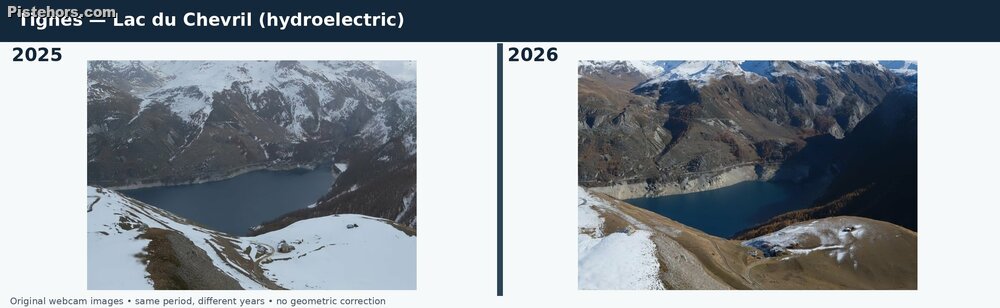
At Tignes, drinking-water supplies are provided by dedicated mountain catchments, while snowmaking draws on separate resources, including Lac de Tignes, the Caffo/Rosière catchment and a withdrawal associated with EDF's Ponturin hydroelectric infrastructure. An environmental assessment published in 2025 reported annual snowmaking withdrawals of approximately 500,000 cubic metres, compared with around one million cubic metres for drinking-water supply.
The drinking-water distribution network was not used to produce artificial snow. Nevertheless, the Lac du Chevril comparison provides a useful illustration of wider questions about water availability and management in the high Alps. The same mountain catchments ultimately support hydroelectricity, drinking-water supply, tourism, agriculture and natural ecosystems, even when the water is collected and distributed through different infrastructure.
There is currently no evidence that major Alpine ski resorts are about to run out of water for artificial snowmaking. The webcam observations do, however, raise legitimate questions about the amount of water already available in some reservoirs as winter approaches. A return to sustained rainfall could improve the situation, particularly where reservoirs are supplied by mountain streams. However, once temperatures fall and precipitation increasingly arrives as snow, immediate runoff into reservoirs may diminish. Snow and rain to 2200 meters is expected in the week running up to the opening of Val Thorens on the 21st November which should provide good conditions, at least on piste.
Paradoxically, a cold, dry start to winter could create ideal conditions for producing artificial snow while providing little additional water with which to make it. For resorts, the challenge is therefore increasingly one of managing three resources simultaneously: natural snowfall, suitable snowmaking temperatures and stored water. The exceptional summer of 2026, followed by a warm and dry autumn, has brought that relationship into sharper focus.