
An extraordinary rescue operation in the Haute-Maurienne has ended with a 39-year-old ski mountaineer found alive despite spending more than a day trapped deep inside a crevasse following an avalanche. He was suffering from severe injuries and hypothermia.
The skier, Émeric, a prolific member of the French ski touring community Skitour.fr where he is known by the username Em42, was eventually rescued on Monday afternoon, more than 24 hours after the accident. Despite suffering multiple fractures to both legs, he had managed to crawl approximately 100 metres through the crevasse before finding shelter in an air-filled cavity between the glacier and the surrounding rock. He remained trapped there until rescuers finally located him by following the sound of his voice.
Émeric, who lives in the Grenoble area, had set out alone on Saturday 7 November for a two-day ski touring expedition in the Haute-Maurienne, close to the Italian border. After leaving Bramans, near Modane, he spent Saturday night at the Refuge d'Ambin (2270m) before setting off at around 8 a.m. on Sunday towards the summit of Pointe Sommeiller (3332m).
According to accounts given by the mountain rescue services, he reached the foot of a steep couloir, where he removed his skis, attached them to his rucksack and began climbing on foot using crampons. It was during this ascent that he triggered a slab avalanche, sweeping him down the mountainside and into a deep crevasse estimated to be around 20 metres deep.The slide happened on a north sector slope around 3200 meters altitude.
The fall caused serious injuries, including a fractured femur in one leg and fractures to the tibia and fibula in the other. Nevertheless, he remained conscious and was able to move further into the crevasse, eventually finding a sheltered cavity where he could survive the freezing conditions. When he failed to return or make contact late on Sunday everning concerned relatives raised the alarm. Mountain rescuers from the CRS Alpes began searching that night, with an initial team reaching the area and identifying clues to his route. However, darkness, difficult conditions and the risk of further avalanches forced them to suspend operations until morning.
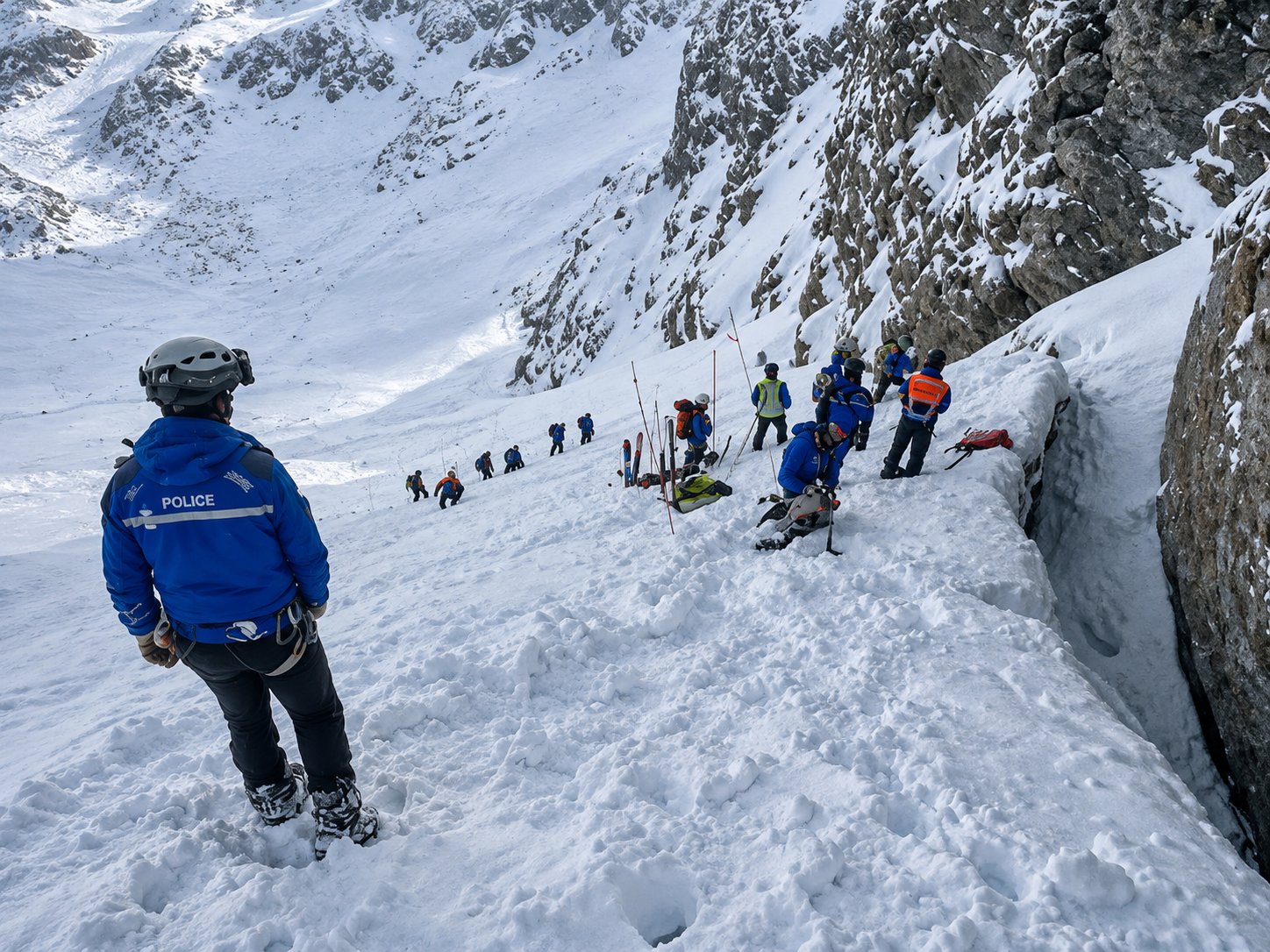
The search resumed early on Monday, supported by helicopters and teams from both the CRS Alpes and the PGHM mountain rescue service. In total, the operation involved 22 CRS officers, six PGHM personnel, two dog handlers, a SMUR emergency doctor and three helicopters.
After locating the avalanche debris, rescuers began a painstaking search, probing the snow and excavating the area for more than five hours. As they dug, they gradually discovered pieces of Émeric's equipment, including a ski and his rucksack. Eventually, they heard a voice coming from deep beneath them. Rescuers established contact and continued digging until they could reach him, approximately 15–20 metres below the surface. He was conscious but suffering from hypothermia as well as severe leg injuries.
He was extracted at approximately 2:30 p.m. on Monday 9 November using specialist rope rescue techniques, then evacuated by helicopter to Grenoble University Hospital.
Major Yoann Haberey of the CRS Alpes expressed astonishment at the skier's survival. Given the severity of his injuries, his location and the length of time he had been missing, rescuers had feared the worst.
Émeric's Skitour profile documents an extensive history of ski touring throughout the French Alps, including demanding routes in the Écrins, Vanoise, Belledonne and Mont Blanc massifs. His outings include technically challenging couloirs and major high-altitude traverses, demonstrating considerable experience in alpine terrain.
The accident is a reminder that even experienced ski mountaineers can be caught by avalanches, even during the early winter season when snow cover is often thin, wind slabs can form locally and glacier crevasses remain poorly covered. News reports claimed that the skier was not carrying an avalanche transceiver (known in France as a DVA) however sources close to the victim say this is incorrect. The circumstances surrounding the use of the transceiver, and why it apparently did not lead rescuers directly to his location, have not been established. This was an exceptionally difficult rescue.
Émeric's ability to move into a sheltered cavity appears to have been crucial. Rather than remaining directly beneath the avalanche debris, he found an air-filled space where he could continue breathing while awaiting rescue but his survival also depended on the determination of the mountain rescue teams, who spent hours working in hazardous terrain despite the threat of further avalanches.
The avalanche risk is low in the sector. There has been around 10cm of fresh snow over the course of Saturday The avalanche bulletin describes a very thin and largely unstable early-season snow cover, with the Mont-Cenis massif currently the least snow-covered in Savoie. Above 2,800 metres on north-facing slopes, around 20 cm of fresh snow has accumulated, with isolated small wind slabs capable of being triggered by skiers or mountaineers, although avalanches are expected to remain small (size 1). Below 2,800 metres, rain and mild temperatures may cause occasional small wet-snow slides. Snow cover is generally insufficient for skiing except on grassy slopes and glaciers above approximately 2,400 metres, with little or no underlying snowpack below 2,600 metres.