
Following a winter disconnected from the Les Sybelles domain, Saint Colomban des Villards is preparing to reopen its ski link for the 2026/27 season following a change in political leadership. The new mayor also has ambitious plans for a €15 million gondola, but the village's awkward mountain geography remains a major obstacle. Could a more direct connection via the Grand Truc provide an alternative? A look at the terrain, ski touring itineraries and mountain biking routes suggests an intriguing possibility.
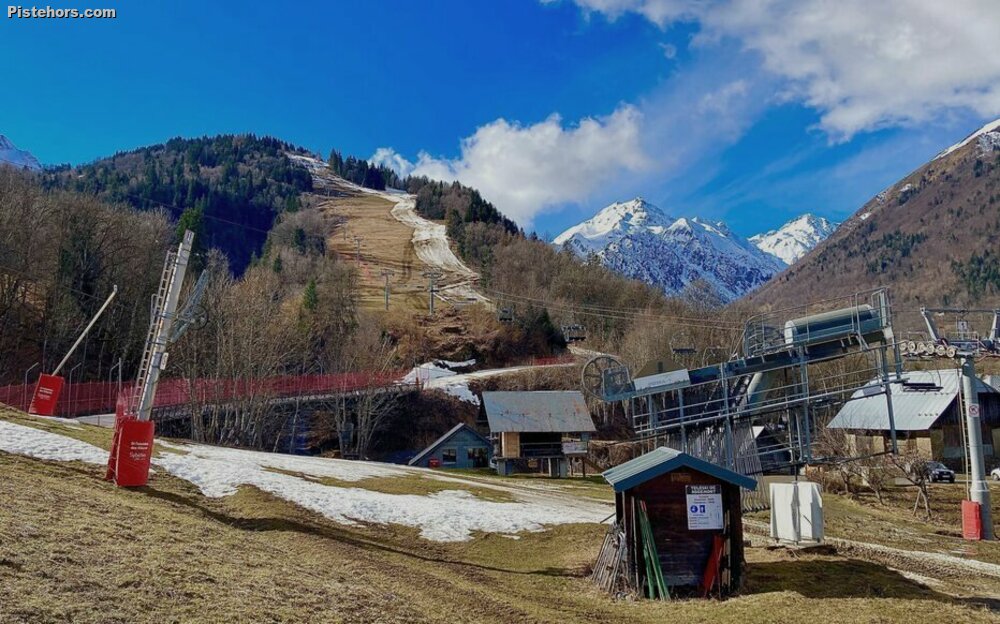
In February 2026, the outgoing mayor of Saint Colomban des Villards, Pierre Yves Bonnivard, declared that reopening the village's ski connection with Les Sybelles was no longer possible. The ski area had accumulated years of operating deficits, its chairlifts required expensive statutory inspections, and attempts to find a new operator had failed. The municipality had concluded that continuing to operate the full ski area was financially unsustainable. Yet less than a year later, Saint Colomban is preparing to welcome skiers back onto the wider Les Sybelles domain.
The change follows the election of a new mayor, Stéphan Pezzani, who has made restoring the connection a priority. Work began during the summer to inspect and refurbish the ageing lifts, with the objective of reopening for the Christmas holidays in December 2026. The planned season runs from 19 December 2026 to 27 March 2027, subject to completion of the necessary inspections and authorisations. It is a remarkable turnaround for a small ski resort that appeared to be heading towards permanent closure.
The immediate reopening is only part of the story. The new administration also has plans for a modern gondola, potentially replacing two ageing chairlifts by 2032. That raises an interesting question. If Saint Colomban is going to invest millions in new infrastructure, should it simply modernise the existing connection, or could there be a better way into Les Sybelles?
Saint Colomban des Villards occupies an unusual position within Les Sybelles, the large Maurienne ski domain linking six villages and advertising some 310 km of pistes. The village sits at approximately 1,100 metres in the Vallée des Villards, only about twenty minutes by road from Saint Jean de Maurienne. It offers a convenient access point for skiers arriving from the Maurienne motorway, as well as a substantial vertical descent from the higher slopes around the Col de Bellard. There is some attractive local skiing, particularly on the sheltered slopes above the village, where snow conditions can be surprisingly good. However, the link with the rest of Les Sybelles is remarkably awkward.
During a visit in February 2022, we found that reaching the upper slopes of Saint Sorlin d'Arves from Saint Colomban took approximately one hour and forty minutes. The journey began with the Ormet chairlift, followed by a descent into an enclosed basin to reach the Charmette chairlift. From there, further lifts carried us towards the Col de Bellard and eventually the central Sybelles network. The route is not simply slow; it involves repeatedly climbing and descending between lifts, with long traverses and relatively little useful skiing along the way. On a piste map, Saint Colomban appears to be connected to the rest of the domain. In practice, it feels more like an isolated ski resort linked to its neighbours by an elaborate transport system.
The reason becomes much clearer when examining the mountains in three dimensions. The Bellard valley reaches Saint Colomban, but its lower section is deeply incised, with steep slopes that make a direct groomed descent towards the village extremely difficult. Instead of following the valley floor, the existing ski runs remain higher on its left bank, exploiting the more manageable terrain. The Ormet chairlift serves the local slopes but does not provide a natural connection to the upper terminal of Charmette. Skiers must descend into a confined hollow before climbing out again. Charmette is therefore an essential part of the connection, rather than simply another chairlift along the way.
Further towards Les Sybelles, the terrain below the main ridge becomes steep and exposed to avalanches. The geography only becomes more accommodating as the valley approaches the Col du Glandon, but even there, the northern slopes present significant difficulties. There is no obvious corridor for a simple new piste or short connecting lift. Indeed, the existing network may represent a reasonably ingenious solution to extremely complicated terrain, despite the inconvenience it causes skiers. That is also why replacing the old lifts with modern equipment may not fundamentally solve Saint Colomban's isolation.
The new mayor has acknowledged that the village cannot build its future around skiing at 1,100 metres. His longer term proposal involves replacing two ageing chairlifts, more than thirty years old, with a new gondola installation. The estimated cost is approximately €15 million, with 2032 mentioned as a possible completion date. The idea is to improve access to higher altitude skiing while developing tourism throughout the year. A gondola would certainly offer advantages. It could carry pedestrians as well as skiers, operate during summer and potentially reduce some of the maintenance and operational difficulties associated with the existing chairlifts. However, the precise alignment has not been established publicly.
If the new installation simply replaces Ormet and Charmette, it may eliminate an inconvenient transfer without changing the lengthy onward journey towards Bellard. The geography would remain exactly as it is today. There have already been attempts to consider more ambitious alternatives.
In April 2024, the previous municipality revealed that it had abandoned a proposal for a direct cableway from the village towards La Pierre du Turc on the Sybelles ridge. At approximately €30 million, the investment was considered unaffordable. A more modest scheme connecting La Pierre with the Combe de Bellard was subsequently examined, but potential piste developments towards the Col du Marolay encountered environmental restrictions because of sensitive species. These proposals demonstrate that the difficulties of the existing connection have been recognised for some time.
The Grand Truc, at 2,209 metres, forms part of the La Toussuire sector of Les Sybelles. Ski lifts already reach close to its summit, and the terrain on the La Toussuire side is relatively open. From Saint Colomban, however, the Grand Truc appears separated from the village by steep, heavily forested slopes. At first sight, a direct ski connection looks unlikely.
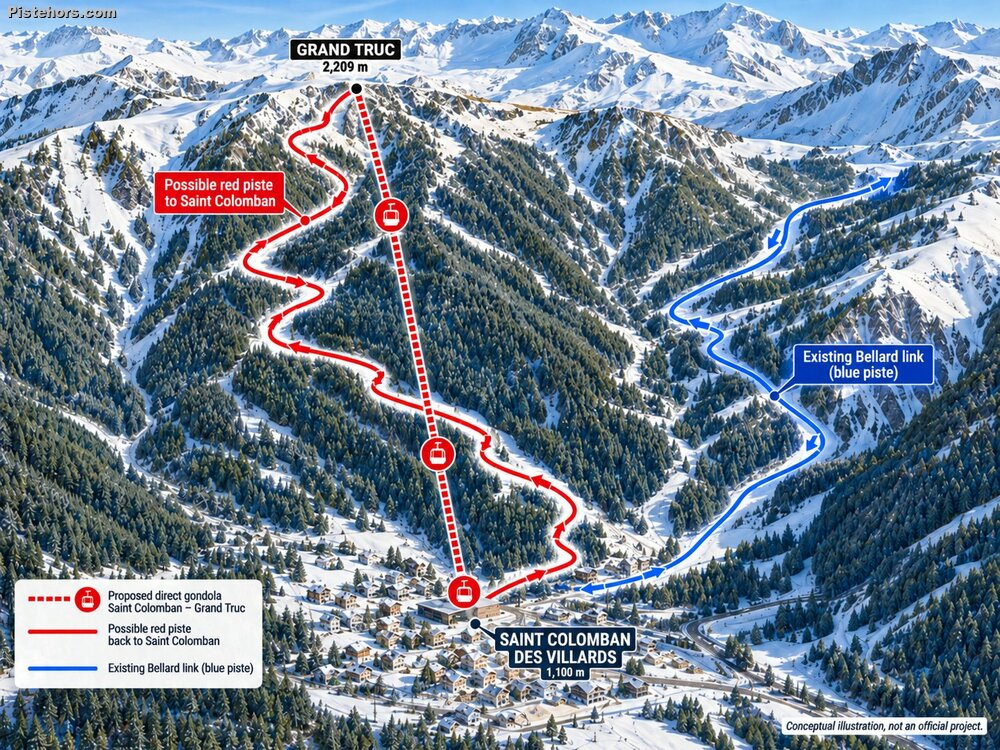
Yet a closer examination of the topography reveals an interesting feature: the Crête de Côte Brune, a ridge running down from the Grand Truc towards the slopes above Nantchenu. Unlike the deeply incised Bellard valley, sections of this ridge appear relatively broad and rounded. More importantly, it is already used by ski tourers. The Skitour website describes an itinerary starting from Nantchenu at approximately 1,100 metres, climbing through the forest towards the Grange du Truc at 1,839 metres, then following the Crête de Côte Brune to the Grand Truc summit. The route is graded 2.2, with an exposure rating of low and a maximum slope of around 30 degrees. All well within the scope of a red piste and a blue piste could be achieved with some terrace work.
This does not mean that a groomed piste would be straightforward to construct. Ski tourers can negotiate narrow paths, steep passages and woodland that would be unsuitable for a conventional ski run. Nevertheless, the existence of an established ski touring route suggests that the Grand Truc ridge deserves closer examination.
There is another interesting source of information: the mountain biking routes that descend from the Grand Truc towards Saint Colomban. These suggest two different possibilities for creating ski pistes. The first follows more technical terrain towards Le Plan. The official black mountain biking circuit, route 66, climbs from Nantchenu along the forest road towards the Grange du Truc before reaching the Crête de Côte Brune and the Grand Truc. For the descent, it uses a steep woodland trail with hairpin bends and exposed roots towards Le Plan, eventually passing beneath the Rogemont chairlift. A ski piste following a similar corridor would probably be relatively demanding. Depending on the terrain, it might be suitable for a red or black run, although significant widening, grading and vegetation clearance could be necessary. The second possibility is the existing forest track through La Frasse.
This winding track climbs from the Nantchenu side towards approximately 1,790 metres, providing access to the upper slopes and eventually the Grand Truc. A groomed piste following the forest road could offer a gentler alternative to the steep descent through Le Plan. In principle, such a route might be suitable for less experienced skiers, although describing it as a future blue piste would be premature without checking its gradients, width and bends. The forest track is already there, which could reduce the need for major earthworks. However, its lower altitude and woodland setting would bring their own challenges, particularly maintaining sufficient snow cover.
Taken together, these routes suggest the possibility of a more direct skiing connection between the Grand Truc and the existing Saint Colomban infrastructure. The critical question is whether they could be adapted into practical, maintainable pistes without unacceptable environmental damage or excessive construction costs. If a suitable skiing corridor could be established, a new gondola might connect Nantchenu directly with the Grand Truc or the Côte Brune ridge .
A preliminary measurement on a three dimensional terrain map suggests a distance of approximately 2.8 km for a possible alignment. Such a lift would be much more direct than the existing journey through Ormet, Charmette and Bellard. Skiers staying in Saint Colomban could reach the La Toussuire sector without negotiating a succession of chairlifts and drag lifts. Visitors from elsewhere in Les Sybelles could also reach the Saint Colomban slopes more easily. The gondola could operate during the summer, carrying walkers and mountain bikers towards the Grand Truc. If the proposed descents proved feasible, the installation might even provide a substantial skiing circuit, combining a direct uphill connection with a long descent towards the village. There is a precedent elsewhere in Savoie.
At Celliers, a gondola provides access to the Valmorel ski area without requiring a groomed piste back to the village. The installation functions primarily as a transport connection, rather than as part of a conventional local ski area. Saint Colomban could potentially adopt a similar model, while retaining skiing on the lower slopes when conditions permit. But the Grand Truc concept would face substantial obstacles.
A lift climbing more than 1,000 vertical metres over approximately 2.8 km would be a major engineering project, requiring careful consideration of tower locations, wind exposure, foundations and avalanche risks. The proposed pistes would also need detailed topographical, environmental and snow reliability studies. There is no published cost estimate for such an alignment, and the €30 million figure previously discussed by the municipality concerned a different project towards La Pierre du Turc. It would therefore be misleading to suggest that a Grand Truc connection could be built for €15 million, or indeed for €30 million, without a proper feasibility study. For the moment, it remains an interesting geographical possibility rather than a developed infrastructure proposal.
Even if a direct Grand Truc link proved technically feasible, Saint Colomban would still face the question of how to finance it. The municipality's ski operations have historically lost between €450,000 and €700,000 annually. Following the exceptionally poor winter of 2023/24, the financial position deteriorated further, with the municipality reporting a deficit approaching €1 million. During winter 2025/26, the village operated only a small beginners' area, with skiing offered free of charge. This considerably reduced the costs of operating the domain. The new administration believes that restoring access to Les Sybelles is essential to supporting the local economy, particularly accommodation providers, restaurants and other businesses dependent on winter tourism.
That argument has merit. A village connected to a major ski domain is undoubtedly more attractive to winter visitors than one offering only a handful of beginners' pistes. But the long term economics depend on more than the number of skiers using the lifts. Saint Colomban must receive sufficient revenue from the wider Sybelles operation to cover its costs. The previous administration complained about the distribution of lift pass income between the different sectors, an issue that any future operating arrangement will need to address. A more direct connection to La Toussuire might increase the attractiveness of Saint Colomban as an entry point, but it would also involve substantial investment and new financial commitments.
The determination to reopen Saint Colomban's connection for winter 2026/27 is understandable. The village has some attractive skiing, a beautiful mountain setting and convenient access from the Maurienne valley. Maintaining its connection to Les Sybelles could play an important role in preserving the local economy. However, the difficult geography that shaped the original lift network cannot simply be ignored. The existing route through Ormet, Charmette and Bellard is awkward because the mountains themselves are awkward. The proposed €15 million gondola may improve comfort and reliability, but if it follows essentially the same route, the fundamental disadvantages will remain. A direct connection towards the Grand Truc presents an intriguing alternative but for now, the immediate priority is to get the existing lifts running again. The challenge will be ensuring that its next major investment provides a lasting solution rather than simply another expensive way around the mountains.