
Eight years after a fire destroyed the Lognan cable car station above Argentière, one of the most ambitious mountain construction projects in the Alps is approaching completion. With an eye watering price tag of €157 million, a summit station designed by Renzo Piano and an extraordinary logistical operation at over 3,200 metres but the reconstruction of Les Grands Montets is about much more than replacing a ski lift.
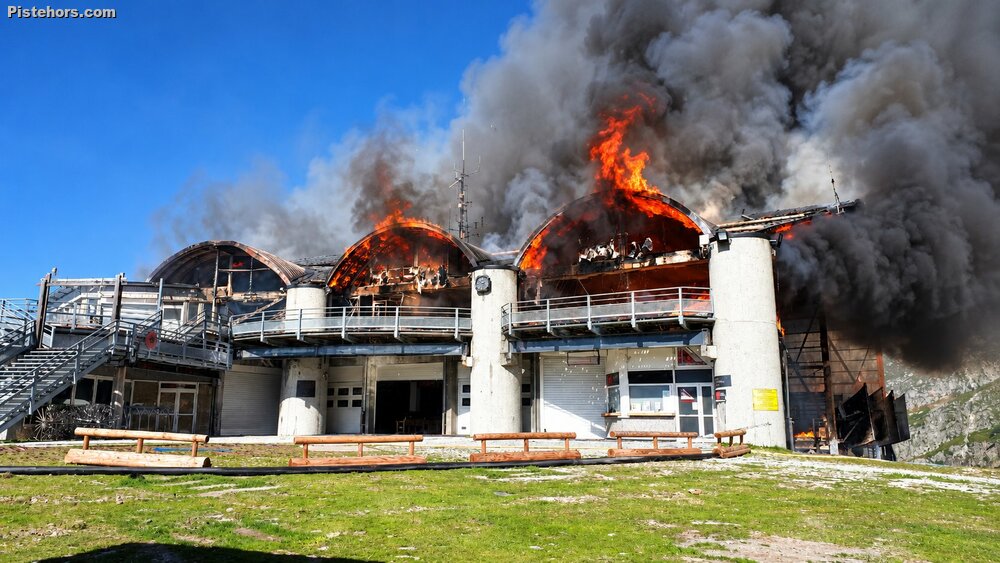
On 11 September 2018, a fire broke out at the intermediate Lognan cable car station above Argentière in the Chamonix valley. The blaze severely damaged the installation and brought an abrupt end to cable car access to the summit of Les Grands Montets, one of the most iconic lift served skiing destinations in the Alps. The origins of the disaster were not eco-terrorists but much more mundane. On 11 September 2018, a specialist subcontractor was carrying out waterproofing repairs to the roof of the Lognan station when a fire broke out in the roof space. Flames rapidly engulfed the building, generating sufficient heat to destroy five of the eight cables serving the two cable car sections. One cabin plunged onto the glacier below. Fortunately, the installation was closed to visitors and nobody was injured.
Eight years later, the summit remains inaccessible by lift. Skiers have continued to use the lower part of the mountain, but the famous descent from the summit, with its spectacular views over the Argentière glacier and Mont Blanc massif, has been missing from the Chamonix skiing experience and is only reachable on touring skis.
The Compagnie du Mont Blanc (CMB), which operates the ski area, could have simply replaced the destroyed installation with something similar. Instead, it embarked on a complete reconstruction, involving new cable transport technology, three architecturally ambitious stations and a fundamental rethink of how the mountain will be used. The result is a €157 million project, with the first new lift scheduled to open in December 2026 and the summit connection following a year later, in December 2027 but why has it taken so long?
The original cable car dated from the 1960s, when building a mechanical lift to the summit of Les Grands Montets was itself an extraordinary engineering achievement. The fire destroyed much of the intermediate station and left the upper section unusable. Rather than simply rebuilding the damaged infrastructure, CMB decided to replace the original system entirely.
Planning and obtaining the necessary authorisations took around five years. The project lies within the protected Mont Blanc massif and required environmental assessments, public consultation and discussions with mountain guides and other local stakeholders. The choice of architect also reflects the scale of the ambitions. Renzo Piano Building Workshop, whose projects include the "marmite" Centre Pompidou in Paris and The Shard in London, was commissioned to design the stations.
At the summit, around 3,250 metres above sea level, the new building will take the form of a glass cube approximately 20 metres across, inspired by the naturally occurring pyrite crystals found in the massif. Steel, glass and timber feature extensively in the new structures. The designs are certainly striking, although some may question whether such a bold architectural statement is appropriate in one of the most spectacular mountain settings in Europe.
The construction itself presents enormous difficulties. At over 3,000 metres, alpine weather severely restricts the building season. Heavy snowfall, strong winds, freezing temperatures and the dangers associated with working on exposed mountain terrain all impose constraints that would be unfamiliar on a conventional building site. Every delay during the short summer construction season can have consequences extending into the following year.
Perhaps the most remarkable aspect of the project is the temporary infrastructure needed to construct the permanent installation. CMB has installed two heavy duty material cableways, known in French as "blondins", capable of transporting loads of up to 10 tonnes. These carry construction materials, equipment and machinery to the different building sites.
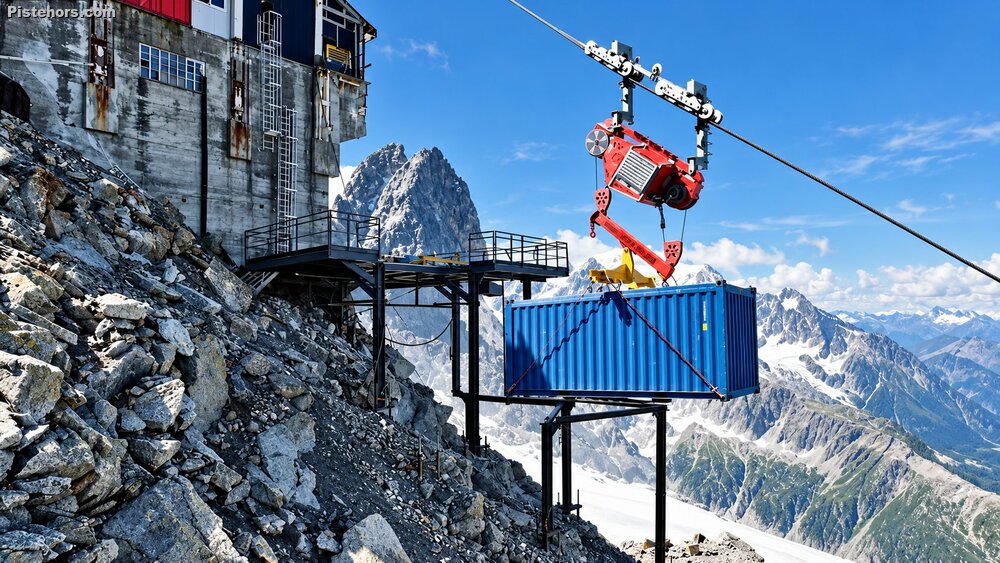
A separate cable car has been installed to transport workers to the summit. Helicopters are still required for certain operations, but the temporary cableways have considerably reduced their use. According to CMB, the system has eliminated the need for approximately 2,500 helicopter flights over the course of the project.
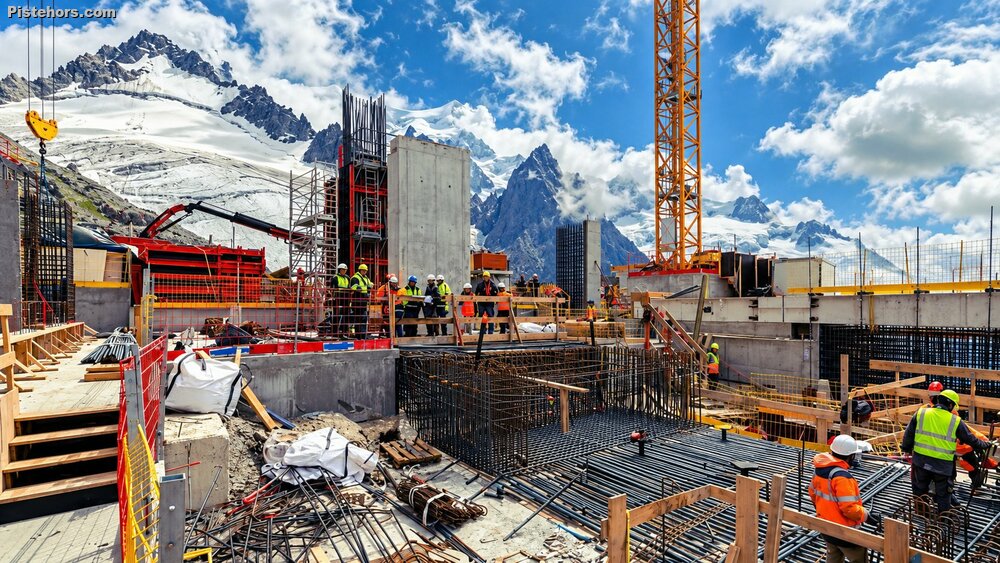
At the height of construction, up to 200 people were working across the different sites, with around 30 companies involved. Coordinating materials, personnel and equipment across several kilometres of steep mountain terrain has required a major logistical operation. The logistics alone account for some €40 million, roughly a quarter of the total budget.
At the summit, workers have also excavated a 65 metre underground gallery connecting the new arrival station to the Col des Grands Montets. The new station has been repositioned on stable rock, another reminder that this is as much a civil engineering project as a ski lift replacement. The scale of the operation helps explain the lengthy construction period, although the years devoted to planning and obtaining approvals have also played an important part.
The replacement installation will consist of two distinct systems.
Unlike the old aerial tramway, which operated large cabins travelling back and forth between stations, the new 3S system will use a circulating system of detachable cabins. Two fixed cables support the cabins while a third provides propulsion. This arrangement combines the stability of an aerial tramway with the operational flexibility of a gondola lift. It is particularly well suited to exposed high mountain locations where wind can considerably restrict operations.
The new system should also offer a more comfortable journey, with seated accommodation and more frequent departures. However, the change raises an interesting question about the character of the summit. Historically, the limited capacity of the old cable car helped regulate the number of skiers reaching the glacier terrain. Access to the summit was something of an event, and queues could be hours on powder days.
A circulating 3S installation changes that relationship. Depending on its operating capacity, it could bring substantially more visitors to an area that has traditionally been relatively isolated from the main ski domain. Whether that proves beneficial for the skiing experience remains to be seen.
There is another important element to the reconstruction. CMB is no longer treating Les Grands Montets primarily as a winter skiing destination. The new installation is intended to operate for around ten months of the year, compared with approximately five months for the former cable car. This is a fundamental change in the business model.
The Grands Montets summit offers extraordinary views of the Argentière glacier, the Aiguille Verte and the surrounding Mont Blanc massif. With improved access and new visitor facilities, it could become a major attraction for sightseers during the summer as well as for mountaineers and skiers. For CMB, this wider appeal may help justify the enormous investment. Rather than relying on winter lift pass revenue, the company can potentially generate income across much of the year. It also reflects a broader trend in the Alps, where operators increasingly seek to develop mountain tourism beyond the traditional ski season.
There is a certain irony here. As climate change makes winter sports less predictable, the industry is investing heavily in infrastructure that allows visitors to enjoy the mountains without necessarily skiing. Climate change presents another challenge to the long term future of the installation. The Mont Blanc massif has undergone significant changes over recent decades, with retreating glaciers, degrading permafrost and increasing instability in some areas of high mountain terrain. These are not purely theoretical concerns. The Bochard gondola at Les Grands Montets required substantial stabilisation work in 2019 following problems associated with ground instability.
The new summit station has been designed with these issues in mind and is being constructed on rock considered suitable for supporting the installation. Nevertheless, the surrounding environment will continue to evolve throughout the expected working life of the new cable car. The Argentière glacier is retreating and the terrain traditionally used by skiers is changing. Crevasse patterns, snow cover and access routes may all be affected. It is therefore legitimate to ask what the skiing experience from the summit will look like in 20 or 30 years.
From a commercial perspective, the emphasis on sightseeing and summer tourism may be a sensible response to these uncertainties. A mountain cable car serving visitors throughout the year is less dependent on snow conditions than one whose principal purpose is to transport skiers. The €157 million investment also illustrates a growing divide within the French ski industry. While the Compagnie du Mont Blanc can contemplate spending such a sum to restore access to a single summit, smaller ski areas are struggling to maintain much simpler installations. Across the Alps and Pyrenees, ageing chairlifts and drag lifts are becoming increasingly difficult to justify economically. Some resorts have already abandoned their alpine skiing operations, unable to finance the replacement of equipment or the costs of maintaining it.
For major destinations such as Chamonix, internationally recognised mountains, substantial visitor numbers and a broad tourism economy make ambitious investment possible. The future of mountain tourism may increasingly involve a small number of heavily capitalised destinations offering sophisticated infrastructure and extensive visitor facilities, alongside smaller mountain communities seeking less expensive alternatives to traditional lift served skiing.By the time the summit cable car finally reopens in December 2027, nearly a decade has passed since the fire. For regular visitors to Les Grands Montets, that is an extraordinarily long interruption, particularly given the importance of the summit to the identity of the ski area. The reconstruction has undoubtedly been technically challenging, and the logistical achievements are impressive. Yet the duration and cost also reflect a decision to transform the installation rather than simply restore what was lost. Whether the investment ultimately proves justified will depend on much more than the number of skiers transported to the summit.
CMB is betting that Les Grands Montets can become a major mountain attraction throughout much of the year, attracting a wider public while retaining its reputation as one of the great skiing locations in the Alps. The new cable car may well be a remarkable achievement of engineering and architecture. The more difficult question is whether the experience it offers will retain the distinctive character that made Les Grands Montets famous in the first place.
There may be another, less obvious reason for the scale of the Grands Montets investment. With scientists monitoring the effects of degrading permafrost on the Aiguille du Midi, and rockfall already disrupting operations, the Compagnie du Mont Blanc faces growing uncertainty over the future of its flagship attraction. The rebuilt Grands Montets, designed to welcome visitors throughout much of the year, could provide a valuable second destination should access to the Aiguille du Midi itself be out of action for some time. There is no suggestion that this is an official contingency plan, but in a rapidly changing mountain environment, having another spectacular summit accessible by cable car may prove to be a useful insurance policy.
References