
At a time when the story of French skiing seems increasingly dominated by small and medium sized resorts closing lifts, reducing their ski areas or disappearing altogether, the Alpe du Grand Serre has produced something rather different: an extraordinary comeback.
Only two years ago the resort appeared to be finished. In October 2024 the Communauté de communes de la Matheysine voted to stop supporting an operation which had accumulated years of deficits. Closure looked definitive after more than 85 years of skiing at La Morte. A remarkable local mobilisation then raised around €200,000, additional public support was found and the resort obtained one final winter. That supposedly final season actually performed rather well, with more than 10,000 skiers recorded by early January 2025 and attendance ahead of the comparison season used by the operator.
Even then, survival was anything but assured. During 2025 SATA Group and the Matheysine authorities spent months trying to construct a long term operating model. In June those negotiations collapsed. In July the closure of the resort was formally approved, with the lifts expected to stop permanently at the end of the summer. The problem was not simply finding somebody capable of operating the lifts. It was finding a way of financing both the annual operation and the investment needed to give a relatively low altitude ski resort a credible future.
Then came another reversal. SATA agreed to carry the financial risk for another winter, giving the Alpe du Grand Serre one more reprieve for the 2025 to 2026 season. Finally, on 30 September 2026, the temporary rescues were replaced by something altogether more substantial. The commune of La Morte signed a new delegation of public service with SATA for 30 years.
There is considerable irony in SATA being the company behind the rescue because it has been here before.
SATA operated the Alpe du Grand Serre from 2001 until 2014. The earlier arrangement was supposed to run much longer, but SATA withdrew prematurely after significant operating losses. One of the problems was that planned tourist accommodation, which was expected to help provide a larger and more reliable customer base, never materialised. The resort then entered a long period of uncertainty during which the public sector increasingly carried the burden of keeping the lifts running.
The SATA returning in 2026 is also a rather different company. It now operates a collection of major Oisans ski areas including Alpe d'Huez, Les Deux Alpes and La Grave. The AGS is therefore no longer an isolated operation. It can potentially fit into a much larger organisation with shared expertise, staff, purchasing, maintenance and marketing.
Fabrice Boutet, SATA's director general, has also made an interesting case for the resort. Not everybody wants to learn to ski at Alpe d'Huez or Les Deux Alpes. A smaller accessible area close to Grenoble has a role in bringing families and new skiers into the sport. That may prove to be one of the strongest arguments for Grand Serre's future.
The Alpe du Grand Serre has always had a slightly awkward economic structure.The ski area itself is surprisingly substantial. It rises from about 1,367 metres to more than 2,100 metres and offers around 55 kilometres of pistes. The upper mountain has genuine alpine terrain, while the long descents through the trees give the area much more character than its modest reputation might suggest.
But the resort has relatively little commercial accommodation compared with the large purpose built French stations. That has always been regarded as an economic weakness because there are fewer captive holidaymakers buying six day lift passes.
For local skiers, however, it is also part of the attraction. During French school holidays l'Alpe du Grand Serre can remain remarkably pleasant while the major resorts become extremely busy. There simply are not enough tourist beds to fill the mountain to the same extent. The limited accommodation which contributed to SATA's departure in 2014 therefore also helped preserve one of the resort's most appealing characteristics.
The challenge for the new agreement is to improve the economics without destroying that advantage. The proposed addition of roughly 300 tourist beds looks fairly modest in that context. It would provide a useful increase in overnight visitors without attempting to turn La Morte into another large purpose built resort. The commune is expected to invest around €5.2 million in the wider redevelopment, while SATA has committed around €9 million towards a new lift giving direct access to the higher ski area.
That must also come as an enormous relief to people who invested in accommodation shortly before the repeated closure announcements. The difference between owning a property in a small functioning ski resort and owning one beside an abandoned lift system is considerable.
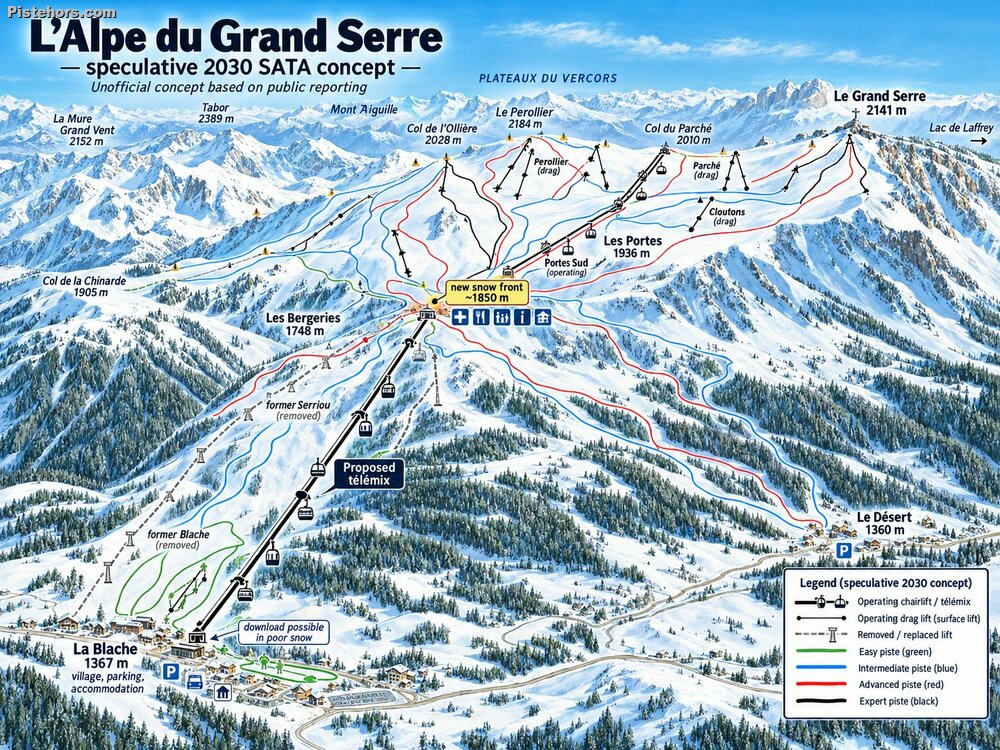
The most interesting element of SATA's plan is not simply the replacement of old lifts. It is the proposed creation of a new front de neige at approximately 1,850 metres by around 2030.
Public reporting says that two existing chairlifts are to be replaced by a télémix, with the Blache chair specifically identified as one of them. The exact alignment has not yet been published, but the logic is clear. Rather than requiring skiing conditions to be good all the way down to La Blache at about 1,370 metres, the new lift should allow skiers to travel from the village directly to a much more snow reliable part of the mountain.
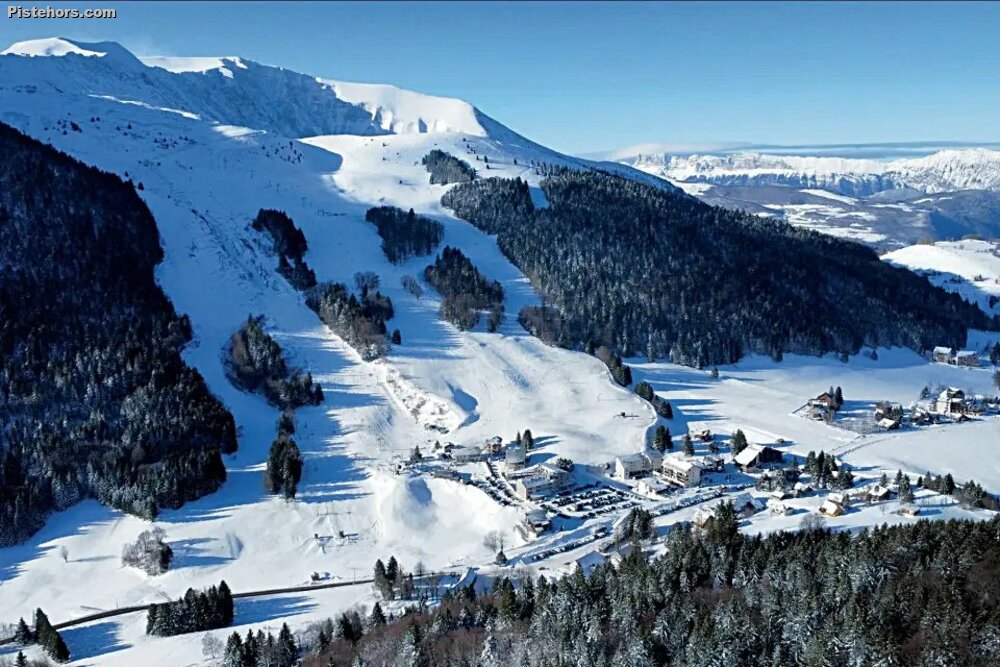
The village, car parks and accommodation can remain where they are. In a good winter skiers will still be able to descend to the bottom. In a poor winter they could take a cabin to around 1,850 metres, ski the upper mountain and return by lift at the end of the day.
In effect, the lower slopes become a bonus rather than a prerequisite.
This is becoming a recognisable adaptation strategy in French skiing. SATA has pursued the same broad principle on a much larger scale at Les Deux Alpes, using major lift investment to make high altitude skiing increasingly independent of conditions lower down the mountain.
Saint Pierre de Chartreuse, with vastly fewer resources, is pursuing a related idea by concentrating skiing on the sectors which have the best chance of remaining viable rather than trying indefinitely to maintain every historic connection.
L'AGS sits somewhere between the two. It does not have the financial firepower or altitude of Les Deux Alpes, but it possesses a useful high mountain plateau between roughly 1,850 and 2,200 metres. If SATA can provide reliable access to it, the resort becomes much less dependent on snow at village level.
Modernisation does not necessarily mean replacing every old surface lift with a fast detachable chair. Anyone who skis Grand Serre regularly knows that the upper plateau can be windy, foggy and thoroughly alpine. In those conditions the old drag lifts have an important advantage. They are comparatively simple and far less vulnerable to wind than large chairlifts.
The difficulty is capacity. At busy periods some of the surface lifts become obvious bottlenecks. A sensible long term plan might therefore keep the basic principle of drag lift access on the exposed upper mountain while replacing the weakest links with modern higher capacity installations.
That would suit l'Alpe du Grand Serre rather well. Spend the serious money on the strategic access lift from the valley floor to the reliable snow, then retain a relatively simple and robust network above it.
L'Alpe du Grand Serre also has to acknowledge an awkward change in its local market. For decades one of its great advantages for Grenoble skiers was accessibility. You could leave the city, drive up through Vizille and be skiing without dealing with the scale, traffic and expense of the major Oisans resorts.
But access to Alpe d'Huez has improved dramatically from the valley. The Eau d'Olle Express at Allemond reaches Oz in about eight minutes, and the newer Poutran gondola has made the onward connection towards the Alpe d'Huez domain substantially easier. Allemond itself is advertised as roughly 45 minutes from Grenoble. For many Grenoblois the effective journey to the Alpe d'Huez ski area can therefore now compete surprisingly closely with the journey to Grand Serre. The road has been improved dramatically with few gradients as far as Allemond.
Grand Serre cannot win that competition by trying to imitate Alpe d'Huez. Its future has to depend on being different.
The obvious target is families. A family with children does not necessarily need 250 kilometres of pistes. It needs reasonable lift pass prices, straightforward parking, uncrowded beginner terrain, places to stop for lunch and enough interesting skiing for the adults. Grand Serre can provide that.
It also has something which is difficult to quantify on a piste map. Some parts of the mountain feel surprisingly wild for a ski area so close to Grenoble. The runs towards Le Désert are perhaps the best example. Descending from the high plateau towards the hamlet at roughly 1,380 metres gives a genuine sense of travelling through the mountain rather than circulating around a resort bowl. There are long changes in landscape, open mountain higher up, forests lower down and the feeling of skiing towards a small isolated settlement rather than a wall of apartment blocks.
It is one of the characteristics that makes Grand Serre much better skiing than its modest lift infrastructure might initially suggest. On a good snow day there is plenty here for an experienced skier to enjoy. On other days its manageable scale makes it ideal for children, learners or groups containing different abilities.
That combination could become its unique selling point: real mountain skiing at family resort prices, close to Grenoble, without the crowds of the major domains.
It would be easy to interpret the 30 year SATA agreement as an attempt to preserve the Alpe du Grand Serre exactly as it is. That would probably be a mistake. The more interesting interpretation is that SATA is trying to preserve what is valuable while changing the parts of the model which have repeatedly failed.
The village stays at 1,370 metres. The attractive lower pistes remain available when snow permits. Accommodation grows, but modestly. Families remain central to the offer. The exposed high mountain retains simple and robust lifts where that makes sense. But the resort no longer depends on being able to ski from the village every day of the winter. That distinction could determine whether Grand Serre merely survives another few years or develops a credible future.
One of the ironies of the Grand Serre project is that its proposed solution has deep roots in the history of French mountain planning. Laurent Chappis, one of the architects who helped invent the modern ski resort, later became increasingly critical of building ever larger settlements at altitude. He argued for a more restrained relationship between tourism and the mountain. Half a century later, modern lift technology makes an idea of that kind increasingly practical: leave the accommodation and permanent infrastructure lower in the valley and transport skiers rapidly to a higher, more snow reliable ski area. What once looked like a compromise may now be becoming one of the most credible models for adapting medium altitude resorts to a changing climate.
There is still plenty that can go wrong. Thirty years on a contract does not guarantee thirty snowy winters, and SATA was the only company to submit an offer for the new delegation. Nobody should confuse the rescue with proof that running a medium altitude ski area has suddenly become easy.
Yet the contrast with the situation in October 2024 is extraordinary. A resort which was voted out of existence, rescued by residents and local businesses, threatened with closure for a second time, formally condemned again and then granted another last minute reprieve now has a 30 year operator and a serious investment programme.
Against the backdrop of closures elsewhere in the French mountains, that makes the Alpe du Grand Serre a rare bright spot.
Perhaps the most encouraging thing is that the plan does not appear to rely on pretending nothing has changed. The proposed 1,850 metre snow front acknowledges the problem and adapts the ski area around it.
If it works, the comeback of l'Alpe du Grand Serre may become more than a remarkable local story. It could offer an interesting example of how a medium sized French ski resort can remain relevant without trying to become a miniature version of the giants next door.