
Many of us have years of training data sitting in silos such as Strava without really doing anything useful with it.
I’m going to show you a tool that can take all of that data, analyse it in detail and turn it into a format that a coach or an AI can read and interpret. You can see what you did well, what perhaps didn’t work, and how your training could be improved, all in a matter of seconds.
The idea is to move away from cookie-cutter training plans and towards something based on your own history. I started this project after reading about a cyclist who exported his Strava activities into Claude AI, all 2,500 of them. But that is an enormous amount of raw data to process, and you are relying heavily on how the AI interprets thousands of individual files. Training Analyser is a lightweight tool designed to make long-term endurance training data easier to understand. It reads activity files including GPX, TCX and FIT, and turns them into a compact dataset that can either be explored directly or passed to an LLM for deeper analysis.
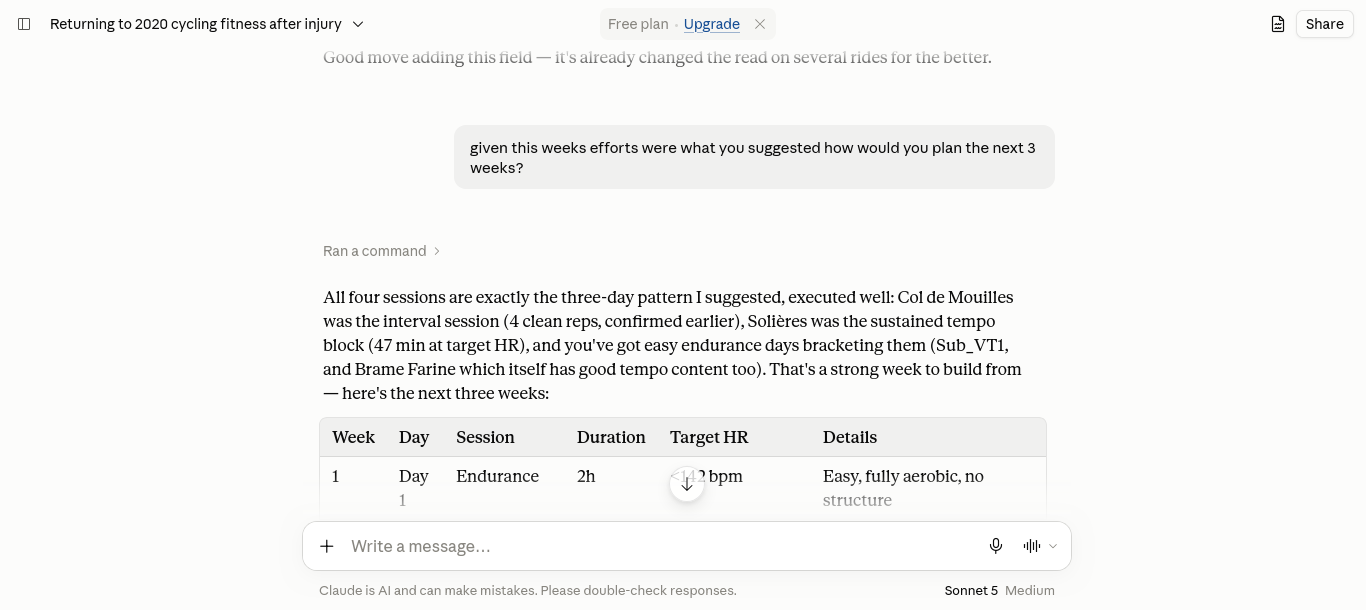
It focuses mainly on heart-rate-based training evidence, which makes it particularly useful for sports such as running, swimming, cycling and cross-country skiing.
It can identify sustained efforts, interval sessions, and time spent below LT1, between LT1 and LT2, and above LT2. It also looks at longer-duration heart-rate efforts that can provide evidence about threshold and endurance fitness. The analyser calculates two simple custom metrics: HR Intensity, which describes how hard an activity was cardiovascularly, and HR Load, which combines intensity with duration.
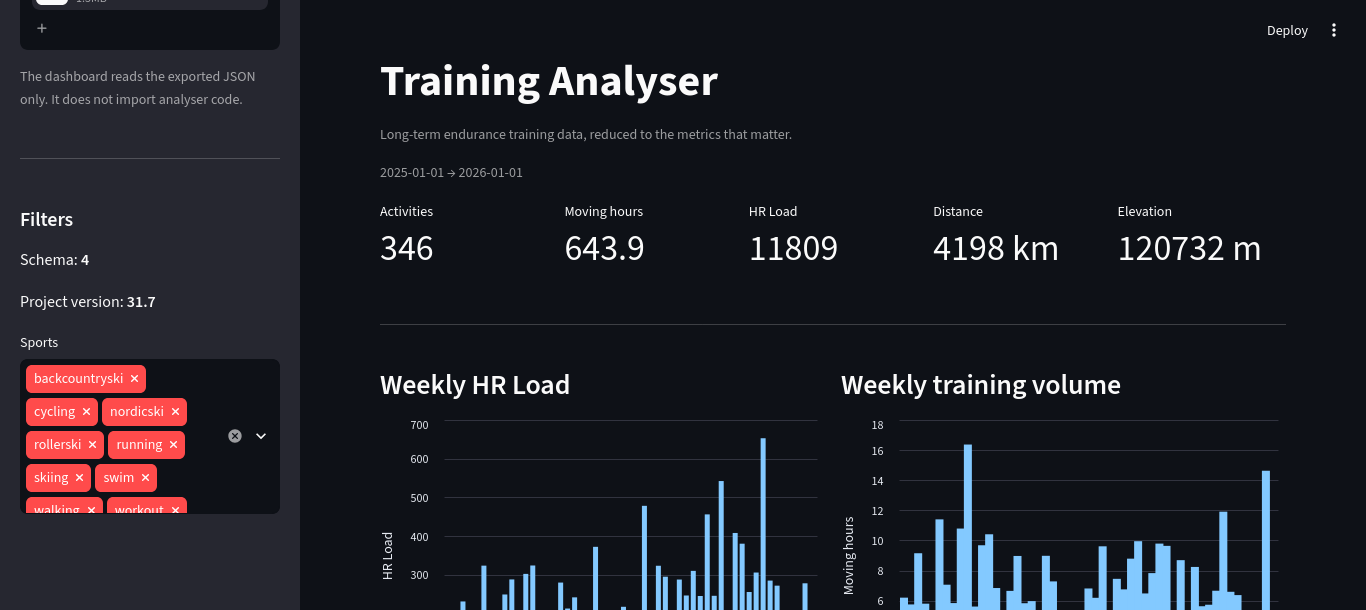
It can also provide evidence for maximum heart rate and help estimate LT1 and LT2 when the data is available. Alongside the physiological analysis, it extracts useful context such as distance, elevation, VAM on climbs, moving time, cadence, equipment and start location.
Activities are classified according to the type of effort, including any sustained tempo, threshold-like or interval blocks within the session.
In short, Training Analyser turns years of raw training files into a small, transparent set of evidence that is much easier for either a human coach or an AI model to interpret.
Although the project is designed primarily to prepare data for AI analysis, there is also a dashboard that visualizes your training history and lets you drill down into individual activities.