
One of the most important gateways to the eastern Écrins has been cut off after exceptional flooding destroyed large sections of the road between Ailefroide and the Pré de Madame Carle. More significantly, local authorities have now said that the road will not be rebuilt.
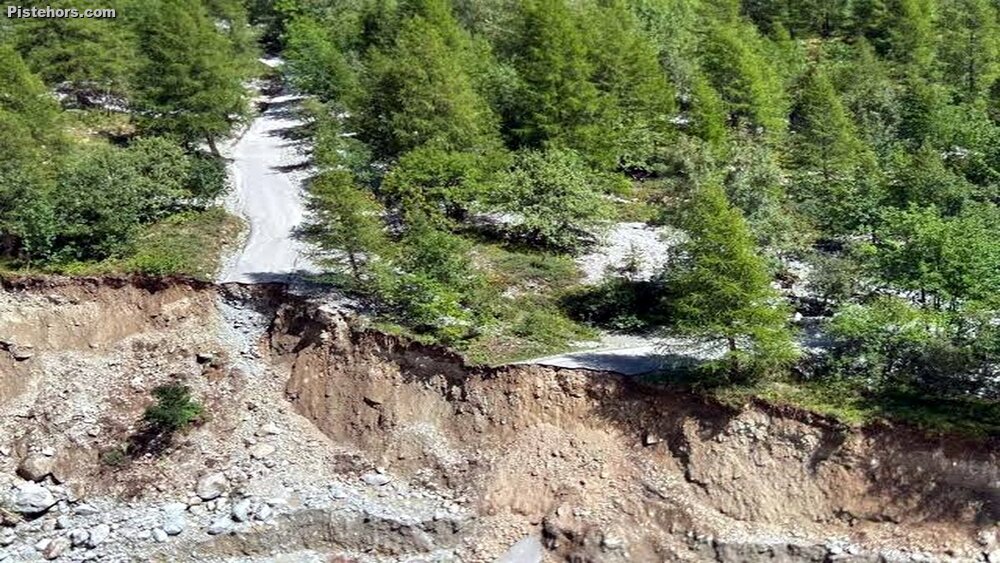
The damage occurred during the night of 27 to 28 August 2026, when violent storms and heavy rain caused several torrents in the Vallouise valley to burst their banks. At the Pré de Madame Carle, the Torrent de Saint-Pierre burst its banks and swept away sections of the RD204T, the mountain road linking Ailefroide with the end of the valley.
It is a major disruption for anyone who knows this side of the Écrins. At around 1,870 metres, the Pré de Madame Carle is far more than a tourist destination. It is one of the principal trailheads for walking, mountaineering, climbing and ski touring in the eastern part of the massif.
From its large car park, walkers normally head towards the Glacier Blanc and Glacier Noir, while mountaineers use the same approach to reach the Refuge du Glacier Blanc and, higher up, the Refuge des Écrins at 3,170 metres. The latter is the traditional base for a number of major routes around the Barre des Écrins, the highest summit in the massif. The official park hiking site currently lists the normal routes to the Glacier Blanc, Glacier Noir and Refuge des Écrins as inaccessible because of the road closure.
Flooding is nothing new at the Pré de Madame Carle. The broad valley floor is a dynamic landscape of torrents, glacial deposits and enormous quantities of sediment brought down from the surrounding mountains. The Saint-Pierre has caused problems before and substantial work has periodically been needed to keep the water in its channel.
Several sections of road were completely destroyed and the Refuge du Pré de Madame Carle itself was flooded. More than 200 people were evacuated from the affected area while the authorities waited for water levels to fall. Fortunately, there were no reported casualties.
The damage extends well beyond the Pré. Elsewhere in Vallouise, roads were affected by landslides, mudflows and torrents, while across the Écrins other trail-head accesses were also disrupted. The road towards Dormillouse was cut, and on the western side of the massif the Vénéon valley suffered further damage, again affecting access beyond Saint-Christophe-en-Oisans.
Initially it seemed that the RD204T would eventually be repaired and reopened. On 2 September, however, local officials announced a much more fundamental decision.
Jean-Marie Bernard, president of the Hautes-Alpes departmental council, and Arnaud Murgia, president of the Écrins National Park, said that the road would not be reconstructed in its previous form. The exposure to repeated natural hazards is now considered too great to justify simply putting the existing road back where it was.
The road had carried around 30,000 vehicles each year, while the Pré de Madame Carle area receives close to 100,000 visitors over a summer season. Its disappearance therefore represents a major head-ache not only for walkers and climbers, but also for mountain guides, refuge guardians and the tourist economy of Vallouise.
This does not necessarily mean the Pré de Madame Carle will become inaccessible permanently. Instead, the authorities are considering a different model for reaching the valley head. Ideas include creating a proper walking route from Ailefroide, establishing a new car park somewhere between Ailefroide and the Pré, and providing restricted access for refuge staff and other essential vehicles via a track. Some form of shuttle access has also been discussed.
For the moment the important point is that the road beyond Ailefroide is closed. It should not be regarded simply as a road closure that can safely be bypassed on foot. Floodwater has changed the terrain, damaged banks and deposited large quantities of sediment, while unstable slopes and rockfall remain possible.
Immediately after the floods, the National Park specifically asked people not to attempt to reach the trails beyond Ailefroide. Its current route information continues to state that access to the Pré de Madame Carle is impossible.
For those with reservations at the Refuge du Glacier Blanc or Refuge des Écrins, the sensible course is therefore to contact the refuge directly and check the latest information from Vallouise-Pelvoux and the Écrins National Park rather than relying on an old map or GPX track.
A pedestrian corridor has subsequently been established around some of the works at Ailefroide, but this should not be confused with restoration of the normal route to the Pré. Construction machinery is operating in the area and conditions are continuing to evolve.
The closure also changes the scale of outings. Ailefroide lies considerably lower and farther down the valley. Reaching the old trailhead from there adds roughly two hours of walking, transforming what was previously an easily accessible starting point into a much more substantial approach. Whether a permanent walking route will follow something similar remains to be seen.
There is a certain irony to what has happened at the Pré de Madame Carle. The landscape that attracts so many visitors is itself the product of the same processes that have now destroyed its road.
The Pré was once occupied by ice. As the glaciers retreated, they left behind a broad expanse of moraine, gravel and sediment crossed by powerful meltwater streams. The Glacier Blanc and debris-covered Glacier Noir have since retreated much farther up their valleys, but the water and sediment coming from the high mountains continue to reshape the valley floor.
The August flood is therefore likely to revive a wider debate familiar elsewhere in the Alps: how much infrastructure should be continually rebuilt in places that are becoming increasingly difficult and expensive to protect? At the Pré de Madame Carle, the authorities appear to have made their decision.
For mountaineers this could mark the end of an era. For decades it has been possible to drive almost effortlessly to nearly 1,900 metres and step out of the car beneath some of the greatest mountains and glaciers in the French Alps. In future, reaching the Glacier Blanc, Glacier Noir and the high Écrins will once more involve a considerably longer approach. Meanwhile 9 cars are currently trapped in the car park and there is a plan to air lift them out.