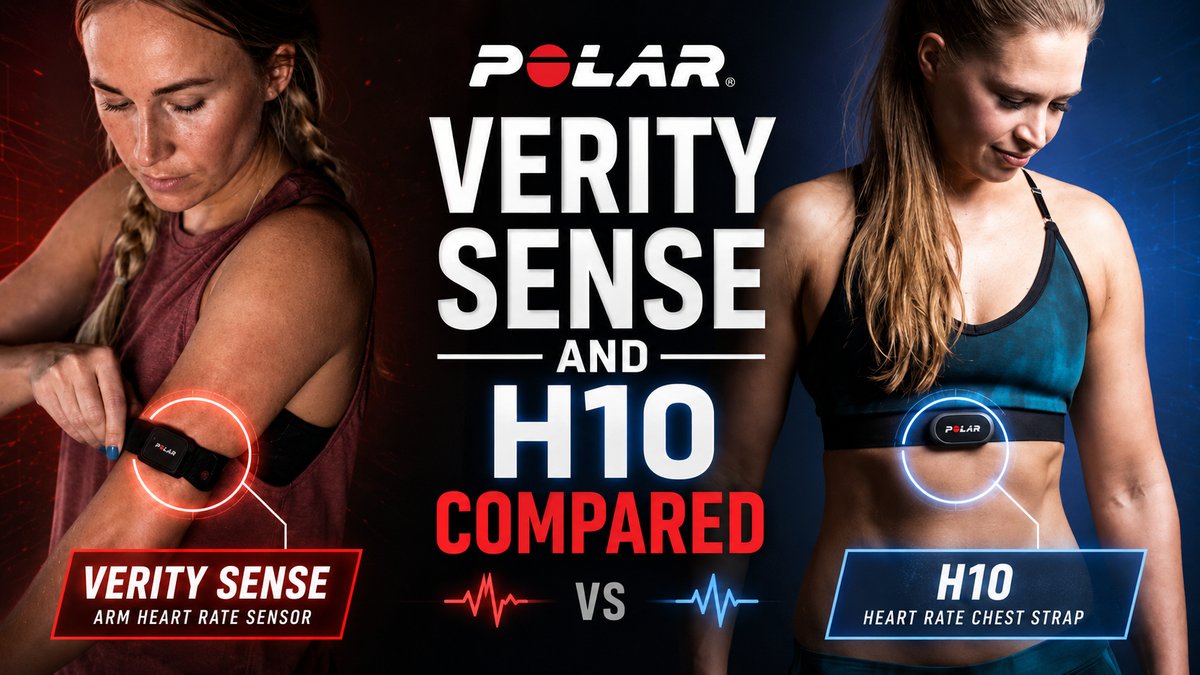
The Polar H10 has long been regarded as one of the benchmarks for consumer heart-rate measurement. Unlike a watch or optical armband, it measures the electrical activity of the heart through electrodes in the chest strap, making it particularly good at detecting rapid changes in heart rate.
The Polar Verity Sense takes a different approach. It uses an optical sensor, or photoplethysmography (PPG), to detect changes in blood volume beneath the skin. Optical heart-rate monitors have traditionally had a reputation for being less accurate than chest straps, particularly during hard exercise, so I wanted to find out how much of a compromise the Verity Sense really represents.
The answer, based on my testing, is: surprisingly little.
TL:DR; The Polar Verity sense offers near chest-strap accuracy, considerably greater convenience, with the main compromise being a few seconds of response lag during rapid changes in intensity.
The Verity Sense is a small optical sensor normally worn around the upper arm. The complete unit weighs just 19 g, while the sensor itself is only 5 g. It is considerably less intrusive than wearing a chest strap and, once positioned correctly, is very easy to forget about.
It supports both Bluetooth and ANT+, including two simultaneous Bluetooth connections and effectively unlimited ANT+ connections. Polar also quotes a transmission range of up to 150 metres. That could be genuinely useful in coached training sessions: an athlete could connect the sensor to their own bike computer while a coach simultaneously receives the data on another device.
There are three operating modes: normal heart-rate broadcasting, standalone recording and swimming. In recording mode the Verity Sense can store a session without needing a watch or bike computer, with Polar now quoting up to 600 hours of training storage. Battery life is rated at up to 30 hours following firmware updates.
The sensor is rated WR50 and a swimming-goggle clip is included. In swimming mode it can be attached to the temple, avoiding some of the problems involved in transmitting heart-rate data through water.
The one slightly inelegant part of the design is charging. The sensor has to be removed from its holder and inserted into Polar's small proprietary USB charging adaptor. It works perfectly well, but it is another small item that is worth not losing.
For the comparison I recorded the Polar H10 and Verity Sense simultaneously on a series of outdoor rides and then overlaid their heart-rate traces.
The rides included steady riding, several short efforts over bridges and longer climbs of around ten minutes. This created quite a useful test because it included both rapid changes in workload and sustained efforts.
At first glance, the traces are remarkably similar.
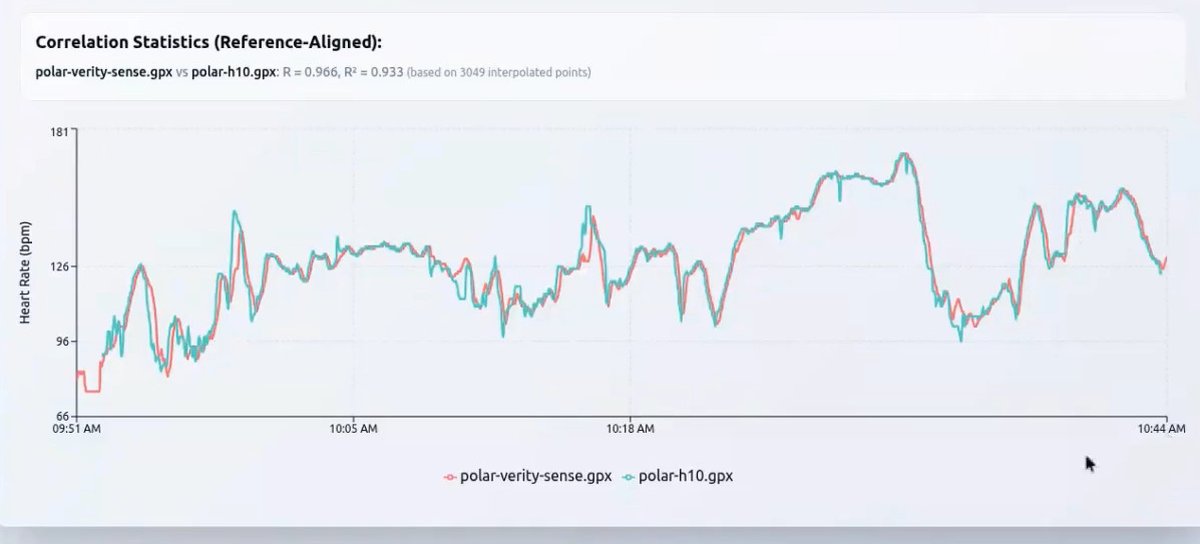
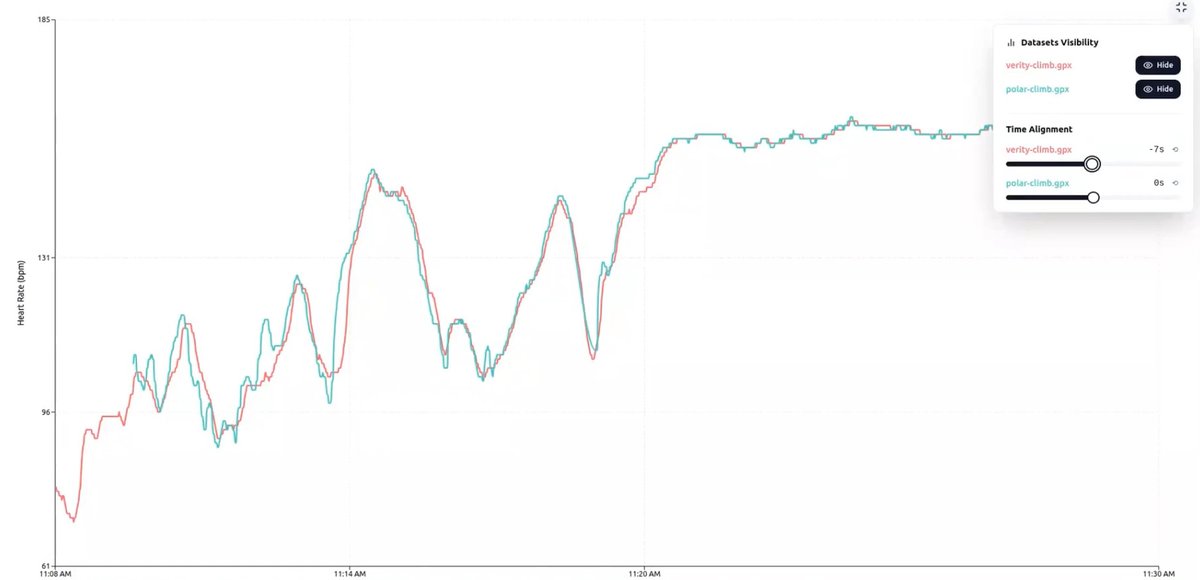
During steady riding and longer climbs, the Verity Sense follows the H10 extremely closely. On a sustained ten-minute climb there is very little to distinguish the two sensors. On another ride incorporating a long climb followed by a descent, the same pattern appeared: once heart rate had stabilised, the optical sensor was essentially tracking the H10.
That agrees remarkably well with independent research. A 2025 validation study comparing the Verity Sense directly with a Polar H10 across activities ranging from rest to cycling and high-intensity intervals found that, when worn on the upper arm, the Verity Sense had an overall mean absolute error of only 1.43 bpm and a mean absolute percentage error of 1.35%.
So the interesting limitation isn't really absolute heart-rate accuracy. It is response time.
When the two recordings are examined closely, the Verity Sense appears to lag the H10 by approximately seven seconds.
Shifting the Verity Sense trace by roughly seven seconds causes many of the peaks and troughs to line up surprisingly well.
This becomes particularly apparent during short, hard efforts. On one sprint the H10 recorded a peak of approximately 148 bpm while the Verity Sense reached about 140 bpm. On another, the difference was smaller, around four beats per minute.
This doesn't necessarily mean that the optical sensor is systematically reading heart rate too low. Rather, the effort is ending while the Verity Sense is still catching up. Consequently, a rapidly rising heart rate can produce a lower recorded peak.
That behaviour is inherent to some extent in optical heart-rate measurement. The H10 detects the electrical signal associated with each heartbeat directly. The Verity Sense measures the resulting pulse wave in peripheral tissue and then has to extract heart rate from that optical signal while filtering motion and other noise.
Polar itself acknowledges that electrical sensors such as the H10 are better at detecting rapid changes in heart rate.
The important point is that lag and accuracy aren't quite the same thing. Over a sufficiently long period, the Verity Sense can be extremely accurate while still responding several seconds later to a sudden change.
It would also be unfair to lump the Verity Sense together with every wrist-based optical heart-rate monitor.
Sensor position matters enormously.
The wrist is a difficult location for PPG. Movement of the hands, gripping handlebars, vibration, changes in wrist angle and relatively poor blood perfusion can all interfere with the signal. The upper arm provides a considerably more stable measurement site.
Recent research supports this. In the 2025 study mentioned above, the upper-arm Verity Sense produced a mean absolute error of just 1.43 bpm, while Polar's wrist-mounted Vantage V2 averaged 6.41 bpm under the same protocol.
Another recent study of PPG placement found that proximal arm positions such as the upper arm generally outperform the wrist, while short, high-intensity activities remain the most difficult conditions because movement artefacts increase.
Earlier testing of the Verity Sense during high-intensity trail running also concluded that it was both valid and reliable when compared with an H10 over the complete exercise session. Interestingly, its results were poorer when only the first five minutes were considered, suggesting that brief or rapidly changing sections are more challenging than longer recordings.
That is very similar to what I found on the bike.
This is where the distinction between heart rate and power becomes important.
Heart rate is already a delayed response to exercise intensity. If you suddenly increase from 200 W to 400 W, the power meter reports that change virtually immediately. Your cardiovascular system does not. Heart rate rises progressively over the following seconds as oxygen demand, cardiac output and other physiological responses increase.
The Verity Sense potentially introduces another delay on top of that physiological delay.
For a 20-second or 30-second sprint, this makes heart rate a poor pacing metric regardless of which sensor you use. Even the H10 may tell you perfectly accurately what your heart is doing, but your heart itself hasn't had time to reach a steady response to the workload.
For this type of training I would use power or even perceived effort to control the interval, and heart rate mainly as information to analyse afterwards.
The Verity Sense becomes progressively more useful as intervals become longer:
This distinction is important because it would be easy to conclude that the Verity Sense isn't suitable for interval training. It is better to say that heart rate itself is not the best real-time intensity measure for very short intervals, and the Verity Sense adds a small additional delay to an already delayed physiological metric.
For longer intervals, threshold work and endurance riding, that matters very little.
Interestingly, the Verity Sense wasn't always the sensor that looked worse in my tests.
There were several sudden drops in the H10 recording that didn't correspond with the effort being made and looked physiologically implausible. The Verity Sense continued smoothly through them.
I've occasionally experienced this with chest straps when the electrodes lose good skin contact. Normally I use electrode gel, but on long rides the contact can still deteriorate as the strap dries.
That illustrates an often overlooked distinction between theoretical and real-world accuracy.
An H10 has the potential to measure individual heartbeats more precisely than an optical sensor. But a perfectly accurate sensor isn't very useful during the seconds when it isn't obtaining a usable signal.
An upper-arm optical monitor avoids the need for electrical contact between chest electrodes and the skin, and in my tests the Verity Sense sometimes produced the more believable recording when the H10 briefly misbehaved.
The Polar Verity Sense is considerably better than the reputation of optical heart-rate monitoring might suggest.
Against the Polar H10, I found it tracked heart rate extremely closely during normal riding, sustained climbs and longer changes in intensity. Independent laboratory research now supports that impression, with upper-arm Verity Sense measurements showing errors of only around 1–2 bpm on average under a range of exercise conditions.
Its weakness is transient response. In my recordings it lagged the H10 by approximately seven seconds and sometimes missed the full magnitude of very short peaks and troughs.
For sprint training, therefore, I would still choose the H10 if I specifically wanted the most responsive possible heart-rate recording, although I might use power rather than heart rate to pace the sprint itself.
For longer intervals, threshold work, climbing and endurance training, I don't think that small delay is particularly important. Once heart rate settles, the Verity Sense follows the H10 extremely well.
Add the greater comfort, dual Bluetooth, ANT+, internal recording, 30-hour rechargeable battery and excellent swimming capability, and the Verity Sense starts to make a very convincing case for itself although the H10 offers most of these features.
The H10 remains the better instrument where instantaneous heart-rate response, ECG-derived beat timing or HRV accuracy is the priority.
But for actually training with heart rate, particularly on the bike, I would be quite happy to use the Verity Sense instead.