
An unusually warm and dry April has triggered widespread and rapid thaw across France’s mountain ranges, cutting short the ski season in many areas and leaving conditions more typical of late spring than mid-April.
Nowhere has the impact been more stark than in the Northern Alps, where snow depths have plummeted over the past three weeks. According to Météo-France monitoring stations, between 50 and 100 cm of snow has disappeared since the start of the month, with daily losses ranging from 1 to 7 cm. As a result, snow cover is now broadly below seasonal norms, giving mountain ranges the feel of a season already over.
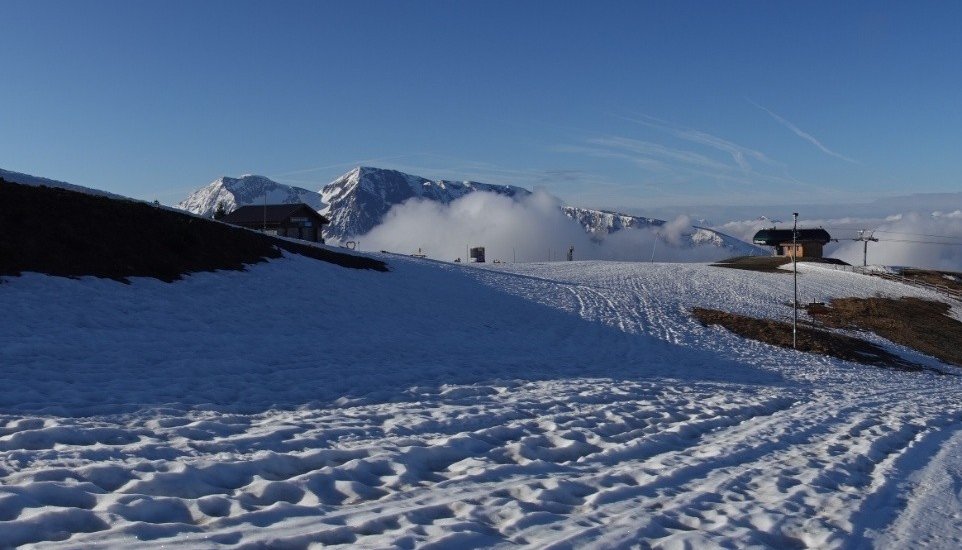 Still snow in the Belledonne but badly sun affected
Even in higher-altitude areas where snowpack remains closer to average, the contrast with past years is striking. In the Écrins, for instance, 225 cm of snow is considered normal for late April but far from the exceptional 485 cm recorded in May 2001. Elsewhere, the situation is more severe: in the Mont-Blanc range, the snow deficit is widespread, and at Col de Porte, snow cover vanished around April 20, roughly ten days earlier than usual.
Field observations from early May paint a bleak picture for late-season skiing. In Belledonne, conditions are already described as resembling the end of the season, with unusually dry high peaks. In the Beaufortain, persistent warmth has left snow cover well below normal, with skiable terrain pushed up to around 1,600 meters on north-facing slopes and closer to 1,900 meters or even higher on sunnier aspects. Below 2,400 meters, the snow has largely transformed into dense, patchy spring snow, often unstable or heavily degraded.
The Southern Alps have seen similarly rapid deterioration. While snow remains at higher elevations, the past two weeks of heat and sunshine have accelerated melting. Snow cover is now statistically comparable to what is typically observed in May. Skiable limits have retreated sharply, rising to between 1,800 and 2,000 meters on north-facing slopes and as high as 2,600 meters on southern exposures. In areas like Thabor, snow depths around 2,500 meters have dwindled significantly, with some monitoring stations already reporting bare ground.
The picture is somewhat different in the Pyrenees, where substantial snow still lingers above 1,800 to 1,900 meters, particularly on north-facing slopes. However, even here, melting has been pronounced, and the remaining snowpack carries an elevated avalanche risk. Layers of desert dust deposited over the winter are now reappearing at the surface, further affecting snow quality.
Corsica stands out as one of the few regions where snow conditions remain relatively favorable for the time of year, especially above 1,900 meters. Yet even there, melt rates of 5 to 10 cm per day are being recorded. Despite significant snow depths at higher elevations, the ongoing thaw and structural weakening of the snowpack, including collapsing cornices and visible ground cracks, underscore the fragility of late-season conditions.
France’s mid-altitude mountain ranges, including the Massif Central, Vosges, and Jura, have effectively already transitioned to summer, with only isolated patches of snow remaining on the highest peaks.
After a winter that promised more, April’s sustained warmth has brought an early and underwhelming conclusion to the ski touring season across much of the country. The shift from winter to spring has been abrupt leaving little opportunity to savor the final turns of the season.