
When I was skiing in le Mont Dore I was told one of the couloirs was named after Joachim Muckenbrunn. A famous Austrian ski instructor and resident of Chamonix. I thought no more of it until I stumbled upon this unsolved mystery.
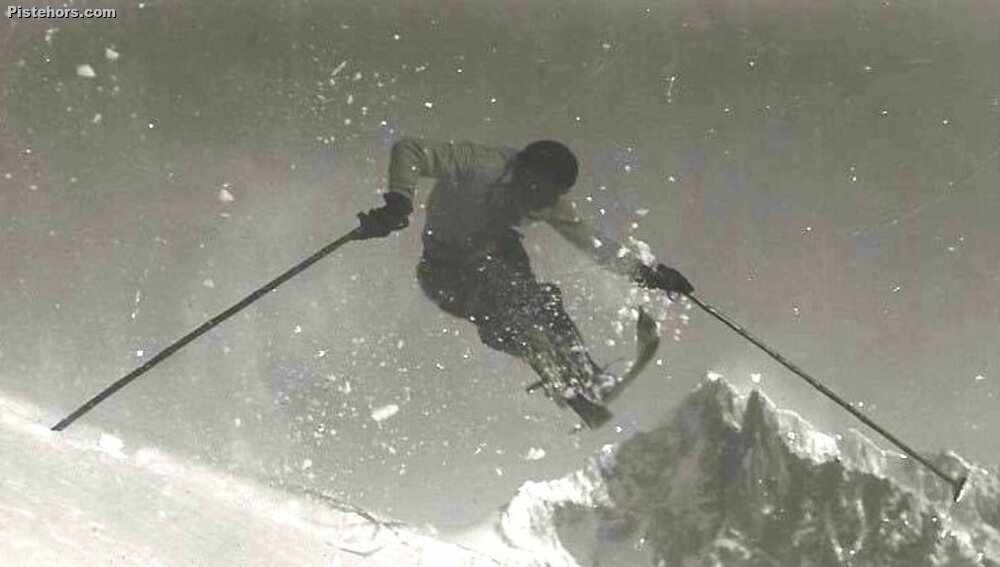 "Muck" in action above Chamonix
Back in the spring of 1956, high on the glaciers of the Mont Blanc Massif, three men vanished into a storm. When their bodies were found days later on the vast expanse of the Vallée Blanche, the tragedy might have been written off as another alpine accident; one more reminder of the mountain’s indifference. But this was no ordinary tragedy.
One of the dead was a fugitive at the center of an international financial scandal. The others were among the most respected figures in Chamonix’s tight-knit mountain community. And the circumstances of their deaths would leave behind a mystery that still lingers todays.
Paul Demarchi was not just a guide; he was a legend. Known as “the Saint Bernard of the snow,” he had carried out dozens of rescues across the massif, sometimes at great personal cost. Years earlier, severe frostbite had led to the amputation of several toes, yet he continued to guide and even took part in the construction of the cable car to the Aiguille du Midi. With him that April was Joachim Muckenbrunn, a former ski champion and charismatic instructor, and their client, Frédéric Ebel.
Ebel, however, was no ordinary client. Born in Poland and naturalized French, he was wanted by police for his role in a vast trafficking network dealing in foreign currency and precious metals. His scheme, involving fake import licenses and international connections, had already drawn the attention of investigators across Europe. In early April, with the net tightening, he fled to Chamonix. His plan was simple in theory: cross the mountains into Italy and disappear.
The cable car was closed for the season so Ebel chose a far riskier route. He would cross the Vallée Blanche on skis, guided by two men who had no idea of his true motives. On April 5, the three set out from Chamonix under a heavy sky, heading toward the Col du Géant and the Italian border beyond.
By the afternoon, the weather had turned. A violent storm swept across the massif, bringing hurricane-force winds, plunging temperatures, and total whiteout conditions. Somewhere in that frozen chaos, the three men lost their route.
What followed can only be reconstructed in fragments. The men were last seen near the séracs of the Glacier du Géant, pressing on while others turned back. After that, nothing much is known.
When rescuers finally reached the area, what they found raised more questions than answers. The bodies were scattered across the glacier, separated by distance and altitude. Ebel lay in a crevasse, likely the shelter the group had used against the storm. Muckenbrunn was discovered not far away. Demarchi, astonishingly, was found near the Aiguille du Midi, just meters from safety, in terrain he knew better than almost anyone.
There were other details, stranger still. None of the men were wearing gloves, despite the lethal cold. Their warm clothing remained in their packs. Near Demarchi’s body were his skis, planted upright in the snow, a silent signal of distress, and fragments of vitamin biscuits.
The autopsy added another layer of uncertainty. Ebel appeared to have died several hours before the other two. Had something happened between them during the storm? Had panic, disorientation, or even conflict played a role in their final hours?
For the first time in France, a mountain accident triggered a full judicial investigation. Police descended on Chamonix, questioning witnesses, retracing movements, and probing Ebel’s criminal connections. Suspicion briefly fell on known traffickers seen in the town, including a man who had met Ebel shortly before the expedition. There were even rumors of poisoning, linked to the biscuits found at the scene.
In the end, the investigation reached a conclusion as stark as the landscape itself: death by cold, exposure, and the brutal force of the mountain. Of course it has to be said that French police investigations, often under political influence, can be a bit suspect and rumours continue to this day.
The Vallée Blanche Affair unfolded in the same turbulent decade as the Vincendon and Henry affair, the Malabar Princess air crash and the death of Louis Lachenal , affairs that exposed the fragility of mountain rescue systems in France. Together, these events would help spark the creation of modern high-mountain rescue units, reshaping safety in the Alps.
But if the institutional legacy is clear, the human story is not. In Chamonix, the case left a deep mark. The death of Paul Demarchi—guide, rescuer, father—shocked the valley. The revelation of Ebel’s true identity only deepened the unease, turning a tragedy into a riddle.
Nearly seventy years on, the Vallée Blanche keeps its silence. The glaciers have shifted, the routes have changed, and the cable cars now carry thousands safely across terrain that once demanded days of effort. But the essential truth remains unchanged.
In the high mountains, certainty is rare. And sometimes, even in death, the full story is never found.
https://www.blogdechristineachamonix.fr/etiquette/paul-demarchi/