Writing a trip report for cross country skiing yesterday I used the term "neige brassée", you'll hear this a lot in cross country circles and it means churned up snow, frequently on climbs, that is tiring to ski. That got me thinking about other mountain expressions I know, here is a short guide if you don't want to pass for a Monchu in the mountains:
Snow conditions: a language of texture
French ski slang is incredibly rich when it comes to describing snow, often with very tactile, almost culinary metaphors.
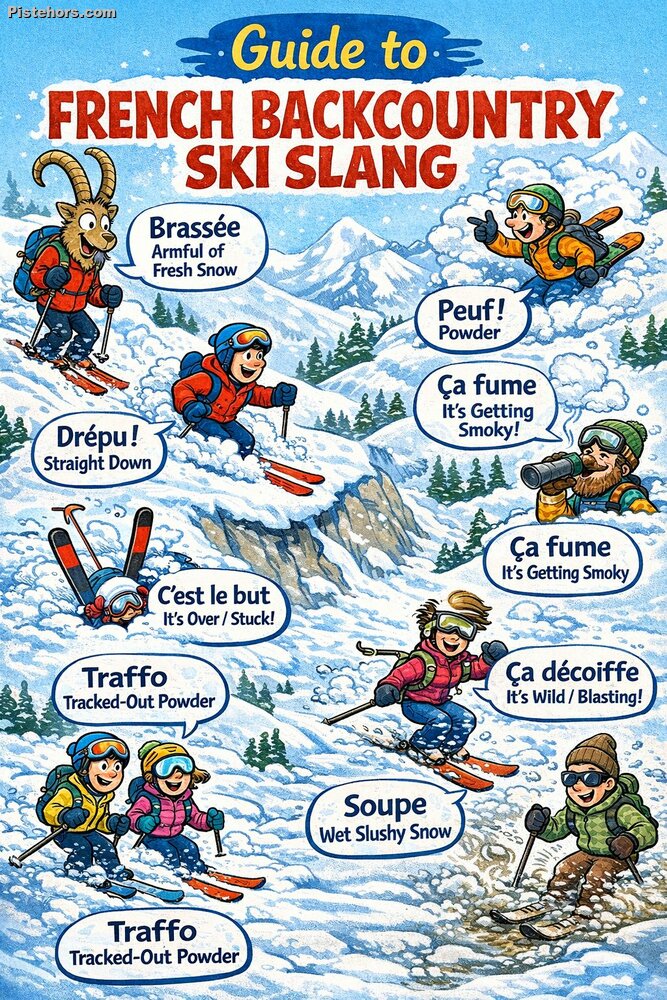
- Peuf - fresh powder (poudreuse)
- Drépu - backslang for powder snow e.g. a donf dans la drépu (a fond dans la poudreuse)
- Moquette - carpet, perfect spring snow but it can be of the type poils courts (short hairs) you skied a bit too early or poils longs (long hairs), you were a bit too late
- Soupe - you really left that descent too late and have found wet, heavy, slow snow
- Semoule - grainy, loose snow
- Neige collante - sticky snow (no glide)
- Neige bof - not great snow, skiable but nothing more
- Neige du cinema - powder like in the ski movies
Some terms describe snow that has been damaged by skiers:
- Traffo (traffolée) - tracked snow, still skiable but needs a bit of technique
- Brassée - fully churned, messy snow, generally on cross country and hard work
- Défoncée - completely destroyed surface
Others relate to wind or refreezing:
- Cartonnée - wind-packed, stiff snow
- Carrelage - broken, plate-like surface (like tiles)
- Croûtée (croutasse) - crust, often breakable and unpleasant
And sometimes it’s not even the snow itself:
- Neige sale - debris (twigs, lichen) in the snow
- Rails lustrés - polished, icy tracks with poor grip, often applied to cross country classic tracks but you might find them ski touring
Visibility and atmosphere:
Mountain language also captures how the environment feels, not just how it skis.
- Purée de pois - (a pea souper) dense fog, very limited visibility
- Jour blanc - flat light, no contrast, terrain unreadable
- Chamois qui fume la pipe - I'm not sure of this one, it could be light mist rising through the forest, poetic and calm OR wind blown snow on ridge lines
- Ça fume - wind blow snow visible, beware of windslab avalanches
- Ça décoiffe - it is very windy (literally it messes with your hair)
Terrain, technique, and movement:
Some expressions describe how you move through the mountain:
- Dre dans le pentu - straight down the fall line
- Ça enquille - it flows, turns link naturally, in The Flow (Boh, les gars, ça y enquille là)
- Ça zippe - very fast glide (especially in cross-country) or a ski touring slope where your skis slide away, time to fit couteaux
- Au taquet - at your limit (see also: à bloc, à donf)
- La Yaute - the Haute Savoie
- Monchu - A tourist (literally Monsieur). Nobody likes a tourist.
- Bauju - les Bauges mountain range
And a few traps along the way:
- Fausse trace - a refrozen track - often from cross country skiers skiing after hours
- Trace gelée / rail béton - frozen, hard tracks
The psychology of skiing
French ski slang shines when describing what’s going on in your head.
- Repofer - (se refaire peur) to scare yourself unnecessarily, eg. "Putain, j'avais gras de marge, j'ai passé ma vie à repofer !" - F**k, I scared myself but I was nowhere near the limit
- On se chie pas là ! - don’t panic
- T’es bien là - Are you ok? said ironically when someone is in trouble
- Ça passe - maybe it does… maybe it doesn’t, generally said at a crux in the ski tour
- Ça envoie du gros - (Send it) This is serious skiing, it is about scale and intensity, e.g. “Les gars derrière, ça envoyait du gros"
- J’ai grave kiffé - really like something, eg. Session peuf, on a grave kiffé.
Philosophy and mountain culture
Some expressions go beyond skiing and reflect a deeper mindset.
- C’est le but - Originally from the Nimp Crew, meaning: we didn’t reach the objective but that is normal, like a SNAFU
- Hold up - unexpectedly great outing, like you “stole” a good day
- Base ! - Ironic - an obvious / no-brainer decision
- Les skis aux pieds, sinon rien - we’re here to ski tour, not walk
These expressions capture something essential success in the mountains, isn’t always about summits, the journey is the reward. French mountain language tends to be:
- understated - pas si pire
- ironic - t’es bien là
- slightly self-deprecating
The important thing to remember is to: rester humble devant la montagne and savoir renoncer.
Even a difficult outing might be described as: Conditions correctes, sans plus