
Avalanches are one of the most serious natural hazards in mountain regions, and clear communication about their risk is essential for saving lives. Across Europe, the avalanche danger scale, a five-level system ranging from Low (1) to Very High (5), has long been the standard tool for informing skiers, mountaineers, and professionals.
The European Avalanche Warning Services (EAWS) are currently in the process of revising the Avalanche Danger Scale to improve its clarity and effectiveness. A recent discussion led by Météo-France raises an important question: is the current scale truly accessible to everyone who relies on it?
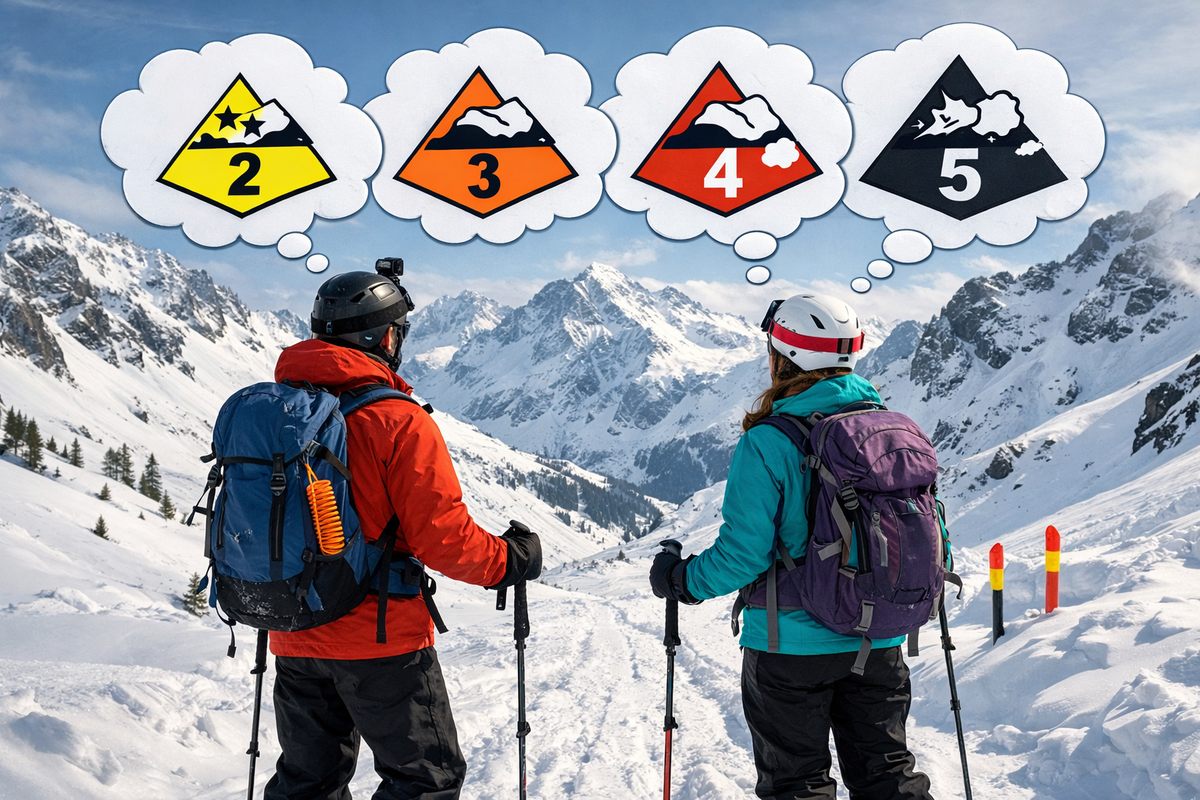
At first glance, the European avalanche danger scale seems simple. Five levels, each with a color and a number. Yet in practice, it can be surprisingly difficult to interpret, especially for recreational users.
One of the main issues is misunderstanding of “Moderate” (Level 2). Many people interpret “moderate” as relatively safe, when in reality it still involves significant risk under certain conditions. In fact, a large proportion of avalanche accidents occur at levels 2 and 3, not just at the highest danger levels.
Another challenge is that the scale combines two different ideas:
This dual meaning can make it harder for non-experts to translate the rating into clear decisions on the ground.
The European Avalanche Warning Services (EAWS) is exploring ways to make the scale more intuitive and actionable. The goal is not to change the science behind avalanche forecasting, but to improve how the information is communicated.
Some of the ideas under consideration include:
The key objective is to ensure that users, especially less experienced ones, can make better decisions faster.
Mountain sports have become increasingly popular, with more people venturing into backcountry terrain. Many of these users may not have formal avalanche training, making clear communication even more critical.
A scale that is misunderstood, even slightly, can lead to overconfidence or poor judgment, particularly in conditions that seem “not too dangerous.”
Improving the scale could therefore have a direct impact on safety by:
We already touched on the interpretation of Avalanche Risk levels in our article Old snow, persistent weak layers and guided groups. In terms of actual incidents the risk of a serious avalanche is 2.5 higher at level ⅖ compared to level ⅕, increasing to 6 times higher at level ⅗. At level ⅗ or ⅘ (or during bad weather) not only were fewer people touring but they were choosing lower peaks and easier tours so the increase in risk is even more acute. When a Persistent Weak Layer (PWL) is mentioned in the bulletin Moderate danger days (⅖ on the avalanche scale) are 50% more dangerous. When the danger is Considerable (⅗), PWL days are twice as dangerous. So a Considerable (⅗) day can be between 6x and12x riskier than a Low (⅕) day. The problem is translating this risk into a simple linear scale. The Swiss have already introduced the +/- system to risk 3.
It’s important to note that this is not about replacing the European avalanche danger scale entirely. Instead, it’s about evolving it to meet modern needs.
Any changes would likely be gradual and coordinated across European countries, ensuring consistency for users who travel between mountain regions.
The avalanche danger scale has been a cornerstone of mountain safety for decades. But as outdoor participation grows and audiences diversify, communication must evolve alongside science.
By making the scale more accessible and intuitive, organizations like Météo-France aim to bridge the gap between expert knowledge and real-world decision-making, ultimately helping more people enjoy the mountains safely.
Invitation to provide user feedback for the EAWS avalanche danger scale: https://uitpsych.qualtrics.com/jfe/form/SV_1UfViWwRyF2Xxsi?Q_Language=EN