
Three people were killed in two separate avalanches on Saturday, February 7, in the French Alps, amid persistently dangerous snow conditions highlighted in official avalanche bulletins and warnings from mountain professionals.
Two ski tourers died on Saturday afternoon after being caught in a large avalanche near Saint-Véran, in the Hautes-Alpes.
The avalanche occurred at around 3:00 p.m., releasing at approximately 2,300 meters altitude on the north face of the Tête de Longet (3146 meters). The slide, described as being of “large scale,” swept down steep north-facing terrain.
The PGHM of Briançon deployed significant rescue resources, including six mountain gendarmes, a dog-handling team, and two emergency doctors from the Hautes-Alpes emergency medical service. Rescue teams were airlifted to the site by helicopter, and search operations continued until nightfall. Despite these efforts, both skiers were found dead.
According to prosecutor Marion Lozac’hmeur, the victims were part of a group of four ski tourers travelling. One of the men, born in 1997, worked in the region, while the other, born in 1991, was domiciled in Haute-Marne. The two remaining members of the group were not injured.
At the time of the accident, the avalanche bulletin for the sector rated the danger level at 4 out of 5 above 2,000 metres, indicating a high risk. Forecasters warned of a typical situation involving fresh snow resting on a persistent weak layer, with an unstable snow-pack remaining widespread at altitude. Powdery slab avalanches were described as likely and often difficult to identify, with easy triggering possible, sometimes remotely, due to the presence of several weak layers.
On north-facing slopes, forecasters warned of the potential for very thick slab failures exceeding one metre, capable of releasing the entire snowpack and generating medium to large avalanches. A surface release was also likely to act as a trigger for deeper, more destructive slides lower down the slope.
Earlier the same day, one person died in a major avalanche near Valfréjus, in the Savoie.
The avalanche occurred at around 1:45 p.m. in the La Belle Plinier sector, near the Grand Vallon, an area accessible on foot. Two members of a guided group of nine ski tourers were swept away. All members of the group were equipped with avalanche transceivers.
One of the victims was rescued quickly, but the second, a tourist in his sixties from western France, was buried for more than four hours. His body was located at around 6:15 p.m. by the PGHM from Modane, despite the deployment of extensive rescue resources, including gendarmes, dog teams, piste patrols, and a helicopter. The skier was found in a terrain trap in the gorges near the bottom of the slope. The avalanche was nearly one kilometre long and up to 2.5 meters deep.
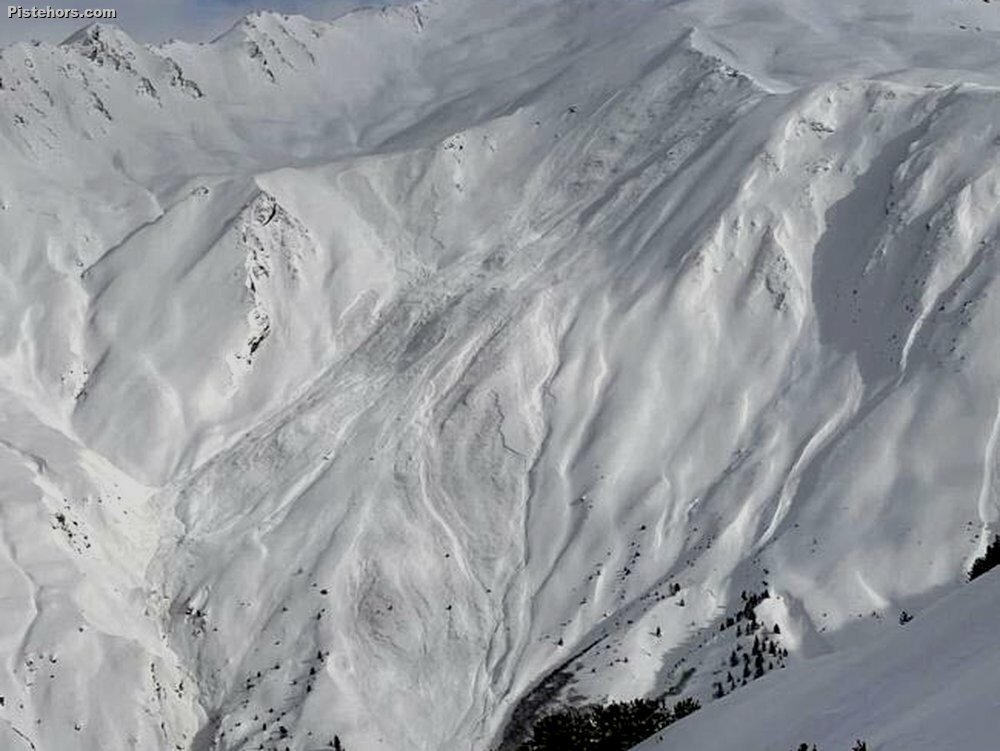 Credit: PGHM Modane
At the time, the avalanche risk was rated 3 out of 5 above 1,800 meters. The bulletin highlighted the presence of a persistent weak layer buried for several weeks, particularly on north, east and west-facing slopes, but also at high altitude on southern aspects. While triggering was becoming less frequent, forecasters warned that any release could result in large, size-3 avalanches, with fracture lines approaching one metre in depth.
The bulletin also stressed the risk of cascade effects, where an initial avalanche in recent snow could trigger a deeper collapse of the underlying weak layer, leading to much larger and more destructive slides.
This latest fatality brings the number of avalanche victims in the mountains of the Savoie to 12 this winter.