
A series of avalanche accidents across the French Alps in late January has left one man dead and several others seriously injured, as authorities warn of exceptionally unstable snow conditions in multiple mountain ranges.
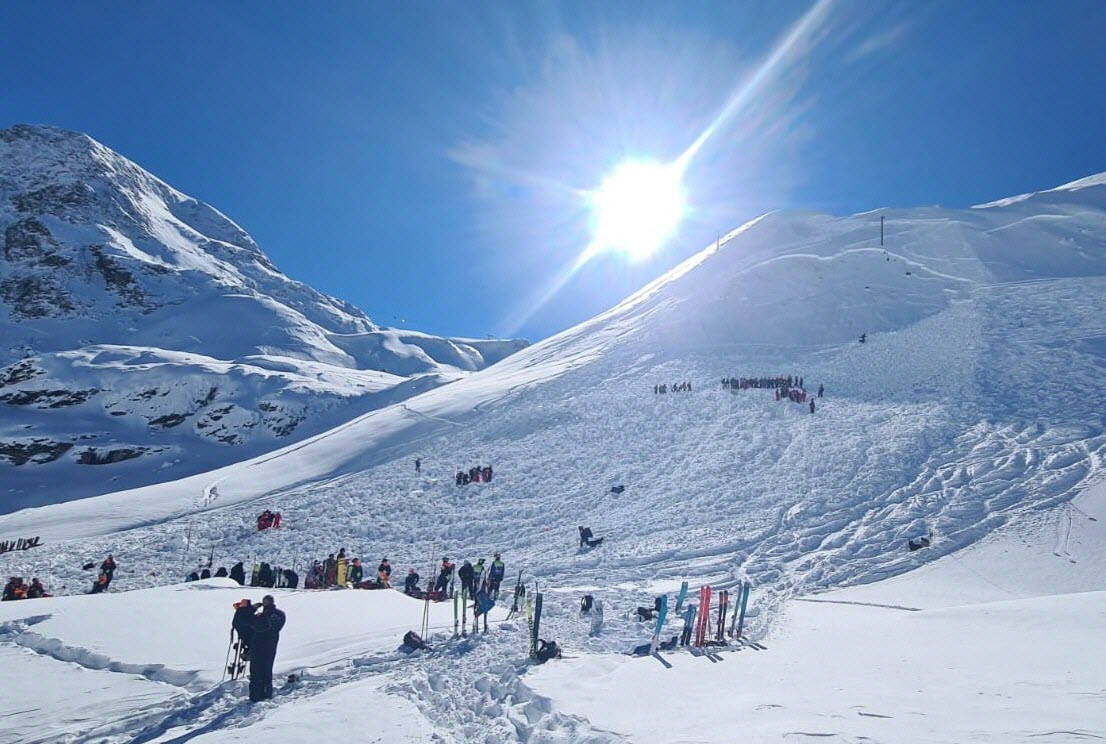 Les Deux Alpes avalanche [credit CRS des Alpes]
On Friday 30 January, a 65-year-old snowshoer was killed by an avalanche in Cervières, in the Hautes-Alpes. The victim, a local resident, was found around 9 a.m. at an altitude of approximately 1,900 metres in an unmarked and unsecured area known as La Chau. The alarm was raised by another mountain user who noticed snowshoe tracks and poles entering an avalanche path without reappearing.
Rescue teams from the CRS Alpes discovered the man’s body downstream from the avalanche debris. The public prosecutor in Gap has opened an investigation to determine the exact cause of death, and an autopsy has been ordered. At the time of the accident, the avalanche risk in the Southern Alps was rated 3 out of 5 (marked), according to Météo-France.
The incident occurred as the Queyras massif was experiencing particularly dangerous conditions. An official avalanche bulletin issued on 29 January warned of a very unstable snowpack at altitude, with a high to very high risk (level 4) above 2,000 metres. Authorities highlighted the presence of wind slabs that were easy to trigger and capable of producing large avalanches.
On Thursday 29 January, a 28-year-old snowboard instructor was buried by an avalanche while riding off-piste with four others in the Bartavelle sector of Valmeinier, in Savoie. Swept away around midday, the man remained trapped under nearly two metres of snow and ice for about 20 minutes. He was located thanks to his avalanche transceiver and dug out by his companions. A doctor who was part of the group immediately began resuscitation efforts. The victim was later airlifted to hospital in Grenoble.
The same day, another avalanche struck near Orcières, in the Hautes-Alpes, involving a lone ski tourer in his forties. The man was caught while descending a very steep slope but was not buried. He sustained a fractured femur and was evacuated to Briançon hospital. Rescue services described him as “extremely lucky,” noting that the avalanche was large and occurred in a known high-risk area.
Also on Thursday morning, a 59-year-old skier was critically injured in an off-piste avalanche at Les Deux-Alpes, in the Oisans region. The avalanche, which occurred at around 2,500 metres in the La Fée Ouest sector, was approximately 50 metres wide and 100 metres long. The victim was found in cardiac arrest beneath about 50 centimetres of snow. Rescue teams managed to restore his heartbeat before he was flown by helicopter to Grenoble University Hospital, where his life remained in danger.
The avalanche risk was 4 (High) above 2000 meters altitude in the area with the main risks being wind-blown snow coupled with a persistent weak layer. Numerous avalanche or approx 30 to 50 cms depth had been observed in Deux Alpes on various slopes and at various altitudes, but especially above 2,000 m. The recent snow covers slab structures formed on Tuesday, March 27 due to strong southerly winds making the terrain very treacherous. On north sector slopes above 2000 m these recent instabilities are locally resting on old layers with angular grains that can promote very large avalanches with the possibility of remote triggering where the snowpack is thinner.
Rescue services and mountain authorities have once again urged extreme caution, reminding the public that avalanche risk remains high, particularly outside marked and secured ski areas. They stress the importance of proper equipment, route planning, and strict adherence to safety advisories in the coming days.
=== update ===
We've been informed that the les Deux Alpes victim never recovered.