
We've all heard the ancients, some of whom have lived in resort since at least last season, pontificate on whether the current winter is good or bad or whether winters ain't what they were but a reanalysis of data for the last 60 years adds some meat to the bones of imperfect memories. Unfortunately the research doesn't cover the dreadful post covid winters, or was that just a bad dream?
The S2M meteorological and snow cover reanalysis provides daily reconstructions of weather conditions and snowpack across the French Alps, the Pyrenees and Corsica from 1958 to 2021. By combining observations with advanced physical models, the dataset allows researchers to compare winters across decades and identify those that were exceptionally snowy or unusually poor.
The data clearly show that the decades following the nineteen fifties included many winters with strong and reliable snow conditions. For example, the winter of 1962/63 stands out as one of the snowiest of the twentieth century. Snowfall began early, temperatures remained consistently cold, and snow depth reached exceptional levels across much of the Alps and the Pyrenees. Snow cover persisted late into spring, even at relatively low elevations.
Another notably good winter was 1977/78, which brought heavy snowfall across large parts of the Alps. According to the dataset, snow depth during mid winter was well above average, and the snow season was both long and stable. Winters like these contributed to long lasting snowpacks that supported water resources and sustained winter tourism.
In contrast, the dataset highlights a growing number of poor winters from the late nineteen eighties onward. One striking example is the winter of 1989 to 1990. Snowfall was late and limited, with frequent warm periods causing precipitation to fall as rain rather than snow at low and mid elevations. Snow depth remained well below average across many massifs, and the season ended early.
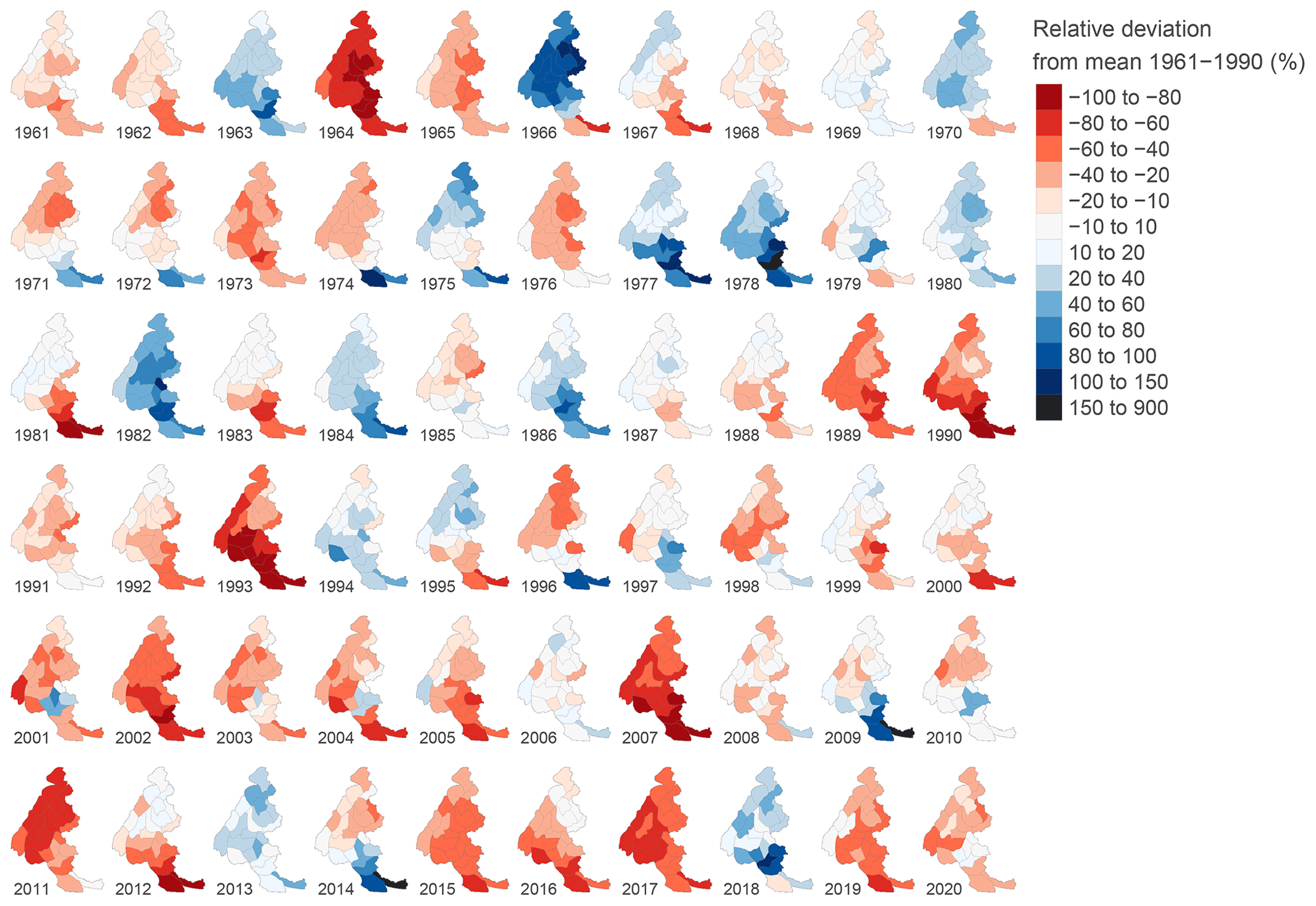 Good winter, bad winter; French Alps
More recent examples reinforce this pattern. The winter of 2006 to 2007 was particularly bad in terms of snow cover, especially below 2000 meters. The dataset shows short snow duration and repeated thaws, which prevented the buildup of a stable snowpack. Ski areas at lower elevations were especially affected.
An even more recent poor winter was 2019/20. The S2M data indicate record low snow depth at many elevations, driven by exceptionally mild temperatures. In some regions, continuous snow cover failed to establish for much of the season, marking one of the worst snow years in the reconstructed record.
The dataset also reveals that not all winters are uniformly good or bad across France. Some years show strong contrasts between regions. A winter that performs poorly in the Pyrenees may still deliver reasonable snow conditions in the northern Alps, reflecting differences in elevation, exposure and atmospheric circulation.
While the dataset was not designed specifically to calculate long term climate trends, the succession of examples over time illustrates a broader shift. Good winters with deep and persistent snowpacks have become less frequent, while poor winters characterized by short snow seasons and low accumulation have become more common, particularly at lower elevations.
The dataset also highlights a clear rise in air temperatures in French mountain regions over recent decades. While the reanalysis was not designed specifically to measure long term climate trends, it shows that winters since the late nineteen eighties have been consistently milder than those of earlier decades. Freezing conditions now occur less frequently at low and mid elevations, increasing the share of winter precipitation falling as rain rather than snow. Extremely cold winters, once common in the nineteen sixties and seventies, have become rare, while unusually warm winters have occurred more often in the past twenty years. This temperature evolution helps explain the shorter snow seasons and reduced snow depth observed across many mountain areas.
These insights are crucial for understanding the future of mountain environments. Snow plays a central role in water storage, ecosystems and winter economies. By documenting both exceptional and deficient winters over more than six decades, the S2M dataset provides a valuable reference for scientists and decision makers facing the challenges of a changing climate.
https://essd.copernicus.org/articles/14/1707/2022/