
Due to advances in electronics portable metabolic carts (met carts for short) are becoming more common at prices that clubs, coaches and even individuals can support. Previousl metabolic carts would cost upwards of $30,000 and require a laboratory to support. A metabolic cart aims to precisely measure the oxygen the subject inhales and the carbon dioxide they exhale during exercises. To do this the subject wheres a mask with pipes connecting to a gas analyser while they run on a treadmill or ride a bike.

At the end of last year we took a look at a new device, the ZoneX from French startup Pairfs based in Grenoble.
First a bit of science. It has been known since the early 19th century that lactic acid found in muscles is related to exertion. In 1930 Harding Owles performed an experiment where he measured blood lactate levels at rest and after walking for 30 minutes at various speeds. Below a certain speed there was no difference between the resting and exercising lactate level but above a threshold lactate begins to accumulate and the difference grows as intensity increases. He had discovered the first lactate turn point and this was an important step to understanding the physiology of exercise.
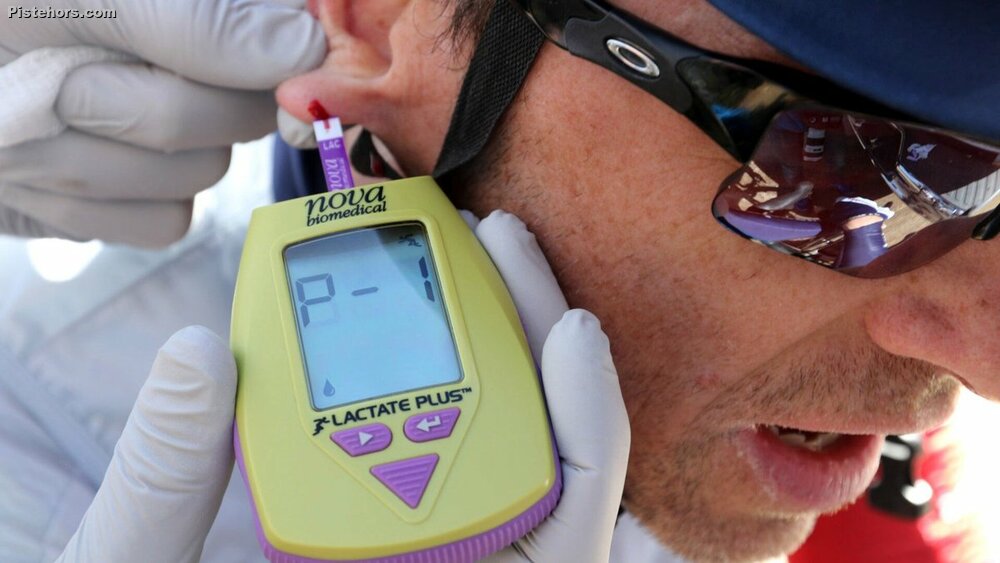 Lactate testing
Nowadays you can measure blood lactate levels with a portable analyser costing a few hundred dollars but the tests are intrusive requiring a blood sample, error prone and difficult to interpret. Zonex monitors air and Carbon Dioxide volumes in breath. We call these VE and VCO2. We will focus on those values as well as a third metric EqCO2: this is the volume of air divided by the volume of CO2. It is basically the quantity of air exhaled to clear one liter of CO2.

Why are these metrics interesting? When we exercise Glucose and Oxygen are combined to produce energy in the form of ATP. The byproducts are carbon dioxide and water vapour. This is aerobic metabolism and the body's preferred way of producing energy to drive muscles. As intensity increases carbon dioxide production increases at a proportionally faster rate than to air volume. EqCO2 drops to a low point or nadir.
As the intensity continues to rise additional energy (ATP) is generated via anaerobic glycolysis. The by-product is lactic acid. V̇CO2 and VE increase in proportion so EqCO2 will plateau. The point where this starts is the first Ventilatory Threshold or first Lactate Turnpoint (LT1). Zone 2 is just below this point.
As exercise intensity continues to increase, lactate accumulates in the muscles because the buffer capacity of hydrogen ions is exhausted (acidosis). This strongly stimulates a ventilatory response and V̇E increases faster than V̇CO2. This is the second Ventilatory Threshold or second Lactate Turnpoint (LT2).
Norwegian coach Olav Aleksander Bu has said “you need to measure regularly in a way that the athlete doesn’t feel is intrusive into their lives”. He sees portable met carts as a tool in that process. They also give the possibility of testing different kinds of sports. You could run the test on a rowing machine and measure your zones in terms of stroke rates or on a ski erg for cross country. You can even take them out of the lab or gym.
I had expected the results to be much easier to read. Lactate testing has the same issues. You rarely get a nice exponential curve and have to test regularly to get the whole picture. Portable met carts are far less intrusive, cheaper than a lab met cart which cost upwards of 30,000 dollars and they don’t require consumables for each test.