
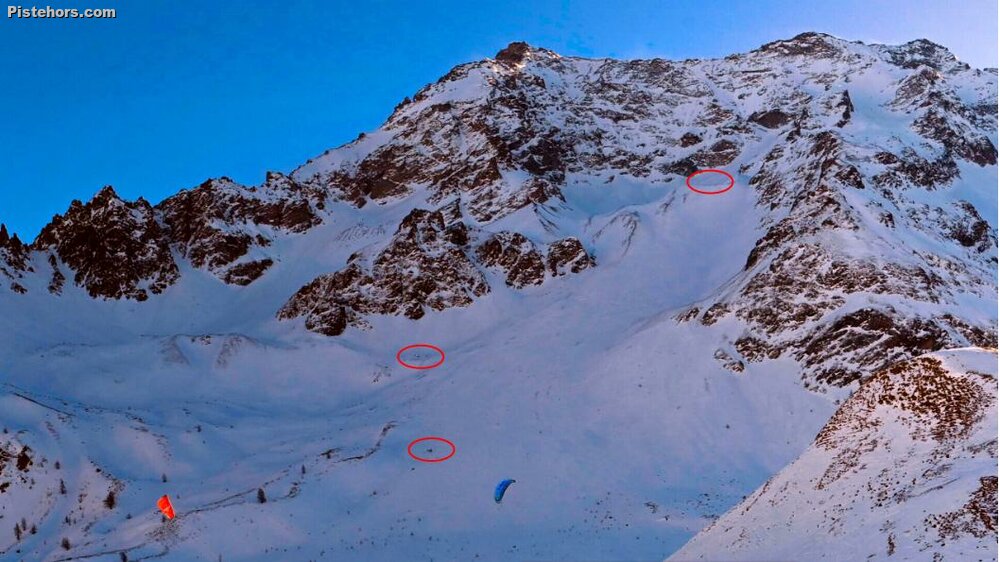
There was a large avalanche at the Col du Lauteret this afternoon in the north facing Combeynot face. The avalanche occured shortly before 14h30 at around 2900 meters altitude on a north facing slope under the pic du Combeynot. Seven ski tourers in three groups were in the area at the time. The route is very popular with ski tourers due to the easy road access. The avalanche ran around 300 meters and injured 3 skiers. The CRS from Briançon and Modane flew to the scene. The victims were air lifted by helicopter to hospital.
For the Oisans, the avalanche risk was 2 above 2500 meters altitude with the risk of small slabs on north sector slopes formed by the wind. The Hautes-Alpes bulletin also gave the risk as 2 but above 2200 meters with the danger of a Persistent Weak Layer added to the wind blown snow with the risk of larger slabs and remote triggering due to the PWL.
On Thursday at about 14h00 four skiers were caught by an avalanche in the vallee Etroite under the Rocher Blanc (2856m) sector near Nevache at 2500 meters altitude. The avalanche occurred on a west facing shaded slope of more than 30°. The avalanche risk was 3/5. A 24 year old man was completely buried under 150cm of snow by the slide. Rescued by his friends he was airlifted to hospital by the Briançon CRS with hypothermia.
https://www.data-avalanche.org/attached-files/desc/1767705224350-1767712460956-Rcit.pdf - article in French on the avalanche above which is very interesting. Here is a brief summary:
The beacon signal was quickly detected but the fine search area was relatively small, accurately pinpointing the victim’s position proved difficult. Probing was initially ineffective due to incorrect probe deployment, including a probe that did not lock properly. This delayed the localization, even though the rescuers were very close to the victim. Eventually the buried person was located at a depth of about 1.5 meters. Digging was particularly challenging because the avalanche debris came to rest on flat terrain rather than on a slope. This made excavation much harder, as the snow was dense and compacted, and removed snow continually fell back into the hole. The rescuers had to rotate roles frequently to maintain efficiency and manage exhaustion while shoveling through the heavy debris.
Once the victim was reached, he was found unconscious but alive. After clearing his head and airway, he showed signs of breathing and regained partial responsiveness. While one group member went to call for external rescue assistance, the others focused on protecting the victim from cold and further harm until help arrived (at 16h10). In their post-accident analysis, the group acknowledged that